![[personal profile]](https://www.dreamwidth.org/img/silk/identity/user.png) alanajoli
alanajoli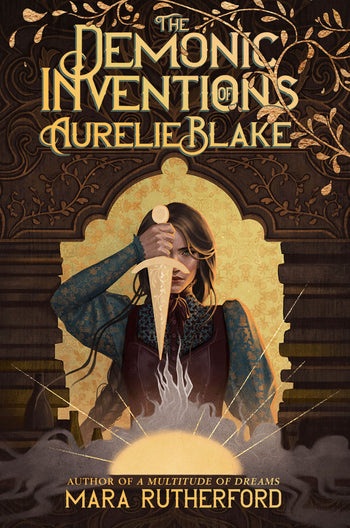
So be warned! The romance between Aurelie Blake and Des Whitlow—an illegal inventor and a demon hunting lawman respectively—does not come to a conclusion in this book. It does have a satisfying build throughout the novel in a way that’s much more Romeo and Juliet than enemies-to-lovers. And while there’s plenty of plot and worldbuilding here, it really is the romance between the two characters that moves the story.
Rutherford’s premise is that there’s an isolationist kingdom cursed with demons every time anyone tries anything new. Art, writing, inventing tools that would improve life—anything that’s creating something spawns a demon. When a baby is born, a natia spawns in the shape of what the child will one day look like. When a person dreams, somnia seep into the world, lazily leaving chaos and destruction behind them. When someone invents, a verita spawns into existence. Under that curse, the kingdom has been kept stagnant for generations.
Aurelie Blake, for one, is sick of it.
She can’t help her creativity. Her drive to invent has made her a strong scientist and university student, as well as a competent demon slayer. Anything she spawns in her lab is her responsibility to put down, she decides, so she’d better be able to handle whatever she creates. It’s a logic that doesn’t apply beyond the walls of the university and her cloistered life; at the beginning of the novel, Aurelie doesn’t really think about what might happen if she isn’t able to contain something. She believes herself to be a person of logic, but she’s as driven by emotion and pride as anyone else. Her journey to that understanding is a big part of her character arc, as well as why she’s a sympathetic character despite her initial lack of self-awareness.
Des, on the other hand, can’t understand the selfishness that would lead someone to create when the inevitable result is such danger for everyone around them. He despises innovators, because his entire life, he’s been surrounded by fellow orphans whose parents were murdered by demons. In their kingdom, all those orphans become members of the Iron Guard, trained to hunt and kill demons in vengeance for their own circumstances—something Des never questions until he’s up for promotion, and until he meets Aurelie.
The Iron Guard starts paying attention to Aurelie not because of her own small inventions (which she has managed ably), but because she’s been approached by a man who had a demon thrall. Des and his peers (especially his best friend Daisy and their fellow guard members Jasper and Gareth) are trying to figure out why a demon consorter has visited the niece of a prominent academic. Des is instantly suspicious of Aurelie’s privilege and naivety; Aurelie is frustrated by how Des disapprovingly looms over her, and given how she’s been dismissed by men in the university as not having relevant opinions due to her gender, she’s not impressed with his glowering. But shortly after meeting, Des saves her life, and the two become emotionally intwined, despite their surface-level dislike.
(As a note, the kingdom is patriarchal and generally white-coded; Aurelie is expected to marry well rather than have her own academic career, for example, and women in the countryside seem to rely on their husbands to be the breadwinners. Despite this, the Iron Guard and its elite unit are both co-ed, which makes the gender balance in the novel layered.)
Of course, Des’s suspicions are justified: Aurelie is up to something. The mysterious man has given her blueprints to build a portal of some kind. And while Aurelie knows the risk of a very large demon will be spawned by such a creation, she can’t imagine finding out that someone else managed the task. So she dives headfirst into danger and magic—and Des and his friends end up diving right along with her.
Through the back and forth perspective, Rutherford gives readers world building on both sides of the university’s iron gate. Des and Aurelie both have access to different sets of information about their world, but they both end up coming to a similar conclusion: Something is corrupt in their kingdom, and it’s not the fault of the curse.
This book really moves quickly through the world building, the plot, the twists (that aren’t entirely unexpected, because readers get the dual POV), and the romance with a satisfying pace—right up until the revelation that this is only book one. (The pacing continues at that point, but of course leaves on a very unsatisfying note to build up to book two.) The romance is more sweet than spice; the physical encounters on the page mainly involve kissing and light touching, reflecting publisher sensibilities toward the YA target audience. (Aurelie is 18; Des is 19. This could easily have been marketed as a new adult closed-door romance as well.) For readers who thought Fourth Wing was a bit much but liked a lot of the political aspects and the grumpy love-or-hate emotional arc for the romantic leads, The Demonic Inventions of Aurelie Blake may hit exactly the sweet spot they’re looking for.
The novel borders on a lot of subgenres—it’s not quite dark academia, it’s at the very oldest range for YA, and it’s an outlier as a sweet-not-spicy romantasy—and ably pulls from the tropes to create an interesting world and storyline. Just be warned: Book two won’t be out until next year, so readers will have to wait to have Aurelie and Des’s fate (and, readers can hope, happily ever after) for another year.
The Demonic Inventions of Aurelie Blake is out now and available at Bookshop.org. Rating: 7.9/10.


