alanajoli: (Default)

Benjamin Franklin once wrote that “in this world nothing can be said to be certain, except death and taxes,” but one of the delights in fantasy novels is that even those aren’t certain. They may well be of concern—especially when the livelihood of an entire village depends on it’s lord being alive and well and keeping the lands out of the hands of his wicked (and ambitious) brother. It’s entirely understandable that in these circumstances, the lord’s widow might seek the help of a necromancer in order to bring back her husband by any means necessary.

Author Caitlyn Paxson, smiling at the camera; she wears a white blouse with a gold scarf
Caitlyn Paxson

But not everyone is nefarious enough to pull off “any means necessary,” and Caitlyn Paxson’s novel A Widow’s Charm, which hits bookstore shelves next week (March 31, 2026), heightens the comedy through misunderstandings, ribald double entendre, and canine hijinks. In honor of the release, Caitlyn answered five questions (with a mini-review that follows!).

Alana: Badly describe your novel in one sentence (and then tell us what it's really about).

Caitlyn: A small dog inherits a manor house and accidentally makes two idiots fall in love.

A Widow’s Charm is the story of a desperate widow who decides she has to resurrect her dead husband so they can save their community from falling into the hands of his horrible brother. To achieve this, she attempts to blackmail the disgraced and deeply depressed necromancer next door. She’s not very good at it, so he thinks she’s trying to seduce him. Misunderstandings, madcap antics, and heartfelt romance ensue.

Alana: Your novel opens with something of a trigger warning—but also with the promise that it will all work out by the end. (As a reader, I forgot all about it until the relevant moment, and it gave me much comfort!) What inspired you to begin with what some readers might consider a spoiler?

Caitlyn: I actually added the sort-of-trigger-warning just before I started querying the manuscript, out of genuine concern! It’s about something in the book that really upsets me when I encounter it in other people’s books (or movies, or… in any media, really) so I wanted to warn readers that it happens and let them know that they don’t need to worry about it because it’s all going to be okay. And I don’t really think of it as a spoiler, because your experience is the intended one! I hope readers have a little laugh at it initially, and then every time it almost happens throughout the book, they think, is it now? And then after it isn’t, they let it slip their minds—and then it happens and hopefully surprises them a little even though they knew it was coming!

Alana: What is your favorite line from A Widow's Charm that you can share without spoilers?

Caitlyn: I’m pretty proud of the first line, which took me a long time to get right:

“Death slipped in at the end of a perfectly ordinary day, creeping over the threshold of evening as if it might go unnoticed—as if the consequences of it would not shape all that was to come.”

But I also have a soft spot for:

“Your badger hound is stuck in my crevasse.”  

Alana: A Widow's Charm feels like cozy fantasy, a romance of manners, and a Regency novel—what were some of your inspirations from those genres that influenced your work?

Caitlyn: I grew up consuming a lot of theatre, and A Widow’s Charm owes much to Shakespeare’s more madcap comedies in particular, like Much Ado About Nothing and A Midsummer Night’s Dream. These plays are hilarious and goofy and full of ribald jokes, but simultaneously deliver incredibly poignant romance and astute observations about what it means to be human. Similarly, The Princess Bride (the movie and the book) was a childhood favorite that really set the tone for me about how to combine fantasy, comedy, and romance.

As far as fantasy novel influences, I’ve been an avid fantasy reader my whole life, so there are endless titles I could list, but one author who has had a profound impact on my writing is my dear friend C.S.E. Cooney, whose stories are so sparkling and inventive that they always excite me. More specifically, her World Fantasy Award-winning book, Saint Death’s Daughter, stars a gentle sweetheart of a necromancer, who inspired me to ponder just how loveable a necromancer could be.

I only really became an avid romance novel reader while I was in the middle of writing A Widow’s Charm, but two authors I quickly fell in love with are Cat Sebastian and T. Kingfisher, and I hope this book is in conversation with theirs.

I love rewatching movie adaptations of Jane Austen novels because they tend to blend costume drama and romcom and that is 100% my jam—my two favorites are Sense and Sensibility (1995) and Emma (2020). These are the sorts of things I would watch in the evening instead of writing if I let myself, so I had to make my manuscript feel like them so I would choose it instead.

Alana: If you could choose one of your characters, from this novel or the next, to spend an evening with, who would it be, and what would you do?

Caitlyn: I think it would be awfully fun to spend an evening out on the town with Elmwood and Winthrop. And maybe after attending the opera and galivanting around the city of Neck, we’ll end up being the subjects of a fabulous highway robbery upon the Wodewood Road when we’re waylaid by Issie and Han from Book 2 (Rogue Charmers, coming in spring 2027)!

Though honestly, an evening curled up with Rollo the badger hound on a chaise next to the fire is probably more my speed.

Cover of A Widow's Charm by Caitlyn Paxson, featuring a stylized border made from objects like a Regency era gun, mushroom, a candle, a book, root vegetables, a pair of scissors, a key, a frying pan, and a cameo brooch with a skull where the face should be; a quote reads "Witty, whimsical, and deeply kind." -Alix E. Harrow
A Widow's Charm


Mini-Review:

It’s easy to tell from her interview answers that Caitlyn is as charming as her characters, and one of the best parts of the book is that the cast is such a sheer delight to spend time with. Hilde, the widow, feels duty-bound to protect everyone (and not really let anyone protect her in return). Elmwood is a soldier, still suffering from his experiences on the battlefield (not to mention being on the run from the law). They’re both people in need of healing, and they don’t expect to find that in each other. But though they both start out thinking they’re using each other, they find real, human connection in the middle of a difficult time, and that sense of joy and hope infuses the novel. There’s never a doubt that these characters will find a way to get to a happy ending, though what that ending looks like is very much in question.

The novel handles the premise of a novel trying to resurrect her dead husband while also falling in love with the necromancer without ever making it feel like something untoward is happening (or, at least, not really). Caitlyn does a fantastic job of exploring Hilde’s relationship with her husband in way that also brings to light class disparity and power inequality, countering that with using privilege for the good of others. How does all of that heavy material fit into a cozy novel? Caitlyn’s use of humor throughout the novel keeps even the heaviest content—and these characters are going through it, so there are definitely heavy themes—from becoming overwhelming.

It also helps that Hilde and Elmwood’s supporting cast are so delightful. Hilde’s stoic sister Han seems, at times, like she’s the sister with the better head on her shoulders. Hilde’s staff—Cook, Francie, and Ed—form a much sturdier base for Hilde than she realizes; her own plots and plans wouldn’t get far without them, though she doesn’t know it! Elmwood’s “betrothed,” Lady Isobel, is the kind of ingenue you might love to hate if only she weren’t also such a wonderful character with steel hidden in her spine. Elmwood’s best friend, Wintrhop, a loveable lawyer whose madcap plans are the only thing keeping Elmwood’s head above water, should get to star in his own book if the series gets to continue that long. The Harrier is the type of villain readers love to hate. But best of all, Rollo the badger hound is such a very good boy! It’s a wonderful cast that feels deep and wide, and like you could spend time with any one of them in a scene and feel the world was richer for it. Rating: 9.5.

There’s still time to pre-order the novel before it comes out! It hits bookstore and library shelves on Tuesday, March 31, 2026.


alanajoli: (Default)

Like other mothers of my era who raised their children on dinosaur shows, I was introduced to the biography of Victorian paleontologist Mary Anning through a 2017 episode of the science-fantasy children’s series Dino Dana. Anning was a real-world paleontologist, a woman fossilist in a time when only men were allowed to join scientific societies. Anning found an ichthyosaur skeleton—the first to be correctly identified—when she was only twelve years old. She also discovered the first pterosaur skeleton (originally named Pterodactylus macronyx) outside of Germany. She knew more about fossils than most of the people who bought fossils from her, and he work was routinely used in the studies of male scientists, who rarely gave her credit.
 

Cover of Jennifer Mandula's The Geomagician, featuring a cameo of a woman and the stylized fossils of ichthyosaur, pterosaur, and ammonite specimens in a Victorian flavored background.

The children’s show only touched on Anning’s history, and it did acknowledge that Anning grew to be respected within the scientific community. She eventually received an annuity from the British Association for the Advancement of Science (thanks to fellow paleontologist and friend William Buckland—more about him in a moment). When she suffered from breast cancer in her 40s, members of the Geological Society raised money to support her in her expenses. When she died at age 47, the Geological Society also helped to fund a stained-glass window placed, in her honor, in St. Michael’s Church in Anning’s hometown.

Anning was a fascinating historical figure, and she becomes a fascinating protagonist in a magical Britain in Jennifer Mandula’s The Geomagician, which releases on March 31, 2026. Mandula uses a lot of historical fact in creating her version of Anning: Mary is a fossilist who caters to wealthy individuals who know less than she does about her discoveries. She’s frequently down on her luck; though she owns Anning’s Fossil Depot, founded by the historical Anning at age 27, it hardly makes the money she needs to survive. Mandula’s Mary is hard-pressed to support an ailing mother, keep her shop open, and feed herself—all while striving to keep up with the latest geomagical discoveries.

Mandula places her Mary in a world where magic can be imbued in objects called reliqs, and fossils are some of the best items for storage. Mary wears an ammonite to collect her magic, which she uses sparingly to help in her discoveries—and also sells it in a place called the Slicks when money is too tight. The wealthy purchase magic that has been sold this way, living in the luxury of magic-lit lights, banquets with magical decoration and illusion (and climate control), all without thinking about those who had to give up their own resources just to survive. Enter Mary’s friend Lucy, a witch (people who can use magic without reliqs) and an activist, who is determined to upend the economy of magical sales. The issue doesn’t seem that important to Mary—it’s just the way the world works—but Lucy is her closest friend, and so she listens with one ear when Lucy describes protests and pamphlets.

When Lucy and Mary go to a recently washed away cliff where Mary is sure she’ll make a discovery that will be her financial salvation, the discovery is more than Mary could have imagined. Not only does she discover a pterodactyl skeleton, but she also discovers an egg—which remarkably hatches in her hands. From there, she’s launched into the perils of scholarly society by her mentor, William Buckland, and her former friend, Henry Stanton, whom she once expected to marry. The two rival scientists are both vying for presidency of the Geomagical Society, and Mary’s discovery has the potential to make either of them the forerunner. Buckland, also a theologian, has a traditional interpretation of how the pterodactyl hatched; Stanton favors a much more heretical, but more plausible, theory, and it’s up to Mary to determine whose position she will support.

The battle between safety and truth weighs heavily throughout the novel, as does the notion that advancement for some may come at the sacrifice of advancement for all. Mandula adeptly shows a very flawed Mary, who doesn’t see how her own plights might extend beyond her own, personal situation. She’s introduced to other women who crave inclusion in the sciences, but she doesn’t see them as relevant to her own desire to belong to the Geomagical Society. She watches her wealthy friend Lucy fight against the injustices of the Slicks, but doesn’t see it as her own cause. Henry and their other friend, Edgar (also Lucy’s brother and a member of the nobility), have other ideas about how to revolutionize the harvesting of magic to make it more humane—and more powerful—in a way that Lucy abhors, but Mary views with an analytical mind, thinking of the possibilities rather than the consequences.

Because the story is tightly told from Mary’s point of view, she doesn’t analyze her own failings, but as the novel expands, Mary’s choices show a larger picture, until finally she can’t avoid the larger truths she’s hidden from. And while some of the bones of the novel’s structure borrow heavily from second-chance romance novels, the romantic subplot really isn’t at the center of the novel. Instead, the core theme is about the interrelations between people, and how hard it is to upend systems designed to keep certain individuals in power, because they’re disinclined to let it go. The result is a very thoughtful book, with cameos from many lauded paleontologists of the era, plenty of references to the historical Anning’s discoveries, and an adorable baby pterodactyl named Ajax.
 

Portrait of Mary Anning with her dog Tray and the Golden Cap outcrop in the background, Natural History Museum, London. This painting was owned by her brother Joseph, and presented to the museum in 1935 by Miss Annette Anning.  Credited to 'Mr. Grey' in Crispin Tickell's book 'Mary Anning of Lyme Regis' (1996)

The historical Mary Anning had a dog, rather than a pterosaur.

The fictionalized Mary certainly lives up to her real-world counterpart’s legacy, and is ultimately, despite her flaws, an easy protagonist to root for. Readers might even be inspired to look more deeply into the real Anning’s life with biographies like Shelley Emling’s The Fossil Hunter (2009). But even without more biographical insight, The Geomagician stands well on its own as both an homage to Anning’s work and a timely fantasy of ethics and justice that ends on a note of hope.

You can preorder The Geomagician at Bookshop.org.

alanajoli: (Default)
It is an era of popularized Greek mythology in so many fields of entertainment: literary (Madeline Miller’s Orange Prize-winning Song of Achilles and Atenaeum Literary Award-winning Circe), online (Epic the Musical, penned by Jorge Rivera-Herrans and recorded by so many the YouTubers), video gaming (God of War and Hades), television (Percy Jackson and the Olympians, based on showrunner Rick Riordan’s series), and books for upper middle graders (Court of the Dead by Rick Riordan with Mark Oshiro).
 
Cover of The Lost Daughter of Sparta by Felicia Day and Rowan MacColl; a black night sky, spangled with stars, looms over a classical Greek cityscape, and a black-haired woman with a golden shawl is turned away from the reader, seemingly beseeching the moon.
The Lost Daughter of Sparta
Those examples are only a sampling, but they show the huge appetite that readers continue to have for the classics, especially when these old stories can reflect modern sensibilities. Riordan and Oshiro’s Court of the Dead questions the idea that monsters should be punished for being who they are. The Lost Daughter of Sparta, a new graphic novel by Felicia Day and Rowan MacColl, has similar themes, questioning not only ideas about monsters, but the roles of women, both mythical and modern, and what costs are involved in choosing a life of one’s own design.
In a very helpful author’s note, writer (and also well-known actor and online creator) Felicia Day describes when she first discovered the story that would become The Lost Daughter of Sparta. During a period of deep diving into Greek mythology, she came across the story of Tyndareus, and how Aphrodite cursed the King of Sparta’s daughters to betray their husbands. And while she knew about Helen, she had never before stumbled across the youngest sister, Philonoe.

In Catalogue of Women, from Hesiod’s writings in the sixth century BCE (quoted in Sententiae Antiquae), the youngest Spartan princess is described with a line that entranced Day:
…And Phylonoe whose body was most like the immortal goddesses. / Her… the arrow bearing goddess / Made immortal and ageless for all days.
But there’s not much more about Philonoe anywhere. (The references cited on Theoi.com, which is a fantastic resource for Greek mythology, are incredibly sparse, lending to Day’s assertion of Philonoe as lost.) It’s no surprise that a creative like Day found these sparse threads and thought there was a story there.

Moved forward by the fantastic artwork of Rowan MacColl, Day’s story introduces a Philonoe whose face was marked at birth—and she was deemed cursed for it, pawned off on goatherds so the king and queen of Sparta didn’t have to acknowledge another troublesome daughter. (Helen was already the cause of the great war when Philonoe was born.) So when Philonoe is called back to Sparta to dutifully marry an ally, she’s happy to do it. Finally, she can serve her family. Finally, she can earn love!

But, of course, it’s not that easy—and love is never something earned. Her mother reveals the family curse, which sends Philonoe on a quest to undo it, performing tasks for Aphrodite in order to be freed. Artemis, who has taken an interest in Philonoe’s story, becomes her guide into a world that is nothing like Philonoe expected.
Spartan princess Philonoe, surrounded by animal carvings; only highlights are in red, and the rest of the images is black & white.
Interior page from The Lost Daughter of Sparta
"She shared bits of history...moments of joy only a mother would remember. And I got to know her wondrous children, almost all of whom were gone. As I worked, I realized why my sister Clytemnestra had done what she had. What else could one do with all that emptiness?"
As the story progresses, Philonoe encounters familiar figures from the myths—the gorgons, Echidna, even Artemis herself—whose tales could be framed as those of wronged women. (The golden bird of Mount Iogos, which Day has given a compelling story of being wronged as a woman, and as a man, and even as a bird, may also be a familiar myth, but a search for the source material there provided no obvious results.) As the princess progresses on her quest, she realizes that her desire to break her curse will not make her happy, but in truth, she’s not sure what will. She feels, understandably, trapped, and unsure how to take the reins of her own life.

Readers will absolutely be urging her own to both greater understanding and to a future that she deserves, and that will make her fulfilled. Day doesn’t give the spoiler about Philonoe’s future (if quoting something from the sixth century BCE can truly be a spoiler) until the very end, but she builds the relationship (and romance) between a lonely Artemis and a doomed princess page by page. Artemis is as haughty and self-righteous as one would expect from a Greek god, but over the pages, she also grows and changes, until the ending leaves readers with a satisfying conclusion to the mystery of this lost mythological figure.

While this is published for adults, it has very young adult themes; Philonoe’s discovery of her place in the world and her decisions to make choices to determine her own path definitely resonate in the YA market. Upper middle graders may or may not be ready for some of the mentions of violence, murder, and assault that are staples of Greek mythology, but those already familiar with a lot of these stories (including versions of Medusa’s myth that fault Poseidon for Medusa’s fate) are unlikely to find this version any more shocking. In fact, MacColl’s illustrations soften many of these themes through the use of mainly black and white art with red accents, which creates some distance (and also evokes classical Greek pottery). Philonoe’s perfectionism and anxiety, her struggles with abandonment and her desire to be loved, all seem likely to resonate with tween and teen readers. That Philonoe comes out the other side better, without sacrificing any of what makes her herself, may offer that audience hope that their future, too, holds brighter days.

Overall, this is a beautifully drawn (both figuratively and literally) story that praises girls and women who know their own minds, and who know they are worthy of love. It deserves a spot in the canon of modern Greek myth retellings. Rating: 9.5/10.

alanajoli: (mini me short hair)
It’s that time of year when people involved with schools—students, teachers, staff, and even parents—are looking ahead to spring break, and the end of the year seems to be approaching with increasing speed. Between the start of the second semester and summer break (for readers in the northern hemisphere), there’s the stress of midterms, but there’s also a sense of potential, that unsatisfactory grades can be fixed before it’s time for that final letter grade. And there’s still time to work on those year-long projects that could make or break a grad student’s future career prospects.

Fantasy fiction, especially for children, has long featured magical schools and camps, and the recent rise in dark academia has added gothic horror flare (and a sharp look at privilege) to the genre. But there’s also plenty of room for fun hijinks in school stories for YA readers—and there’s an even wider potential to tell new stories within SFF that feature grad school students and other academics. If you’re school-affiliated and need a mid-semester boost, if you miss your own days in academia, or if you just like to dabble in the school setting, here’s a syllabus you can use for your own study!

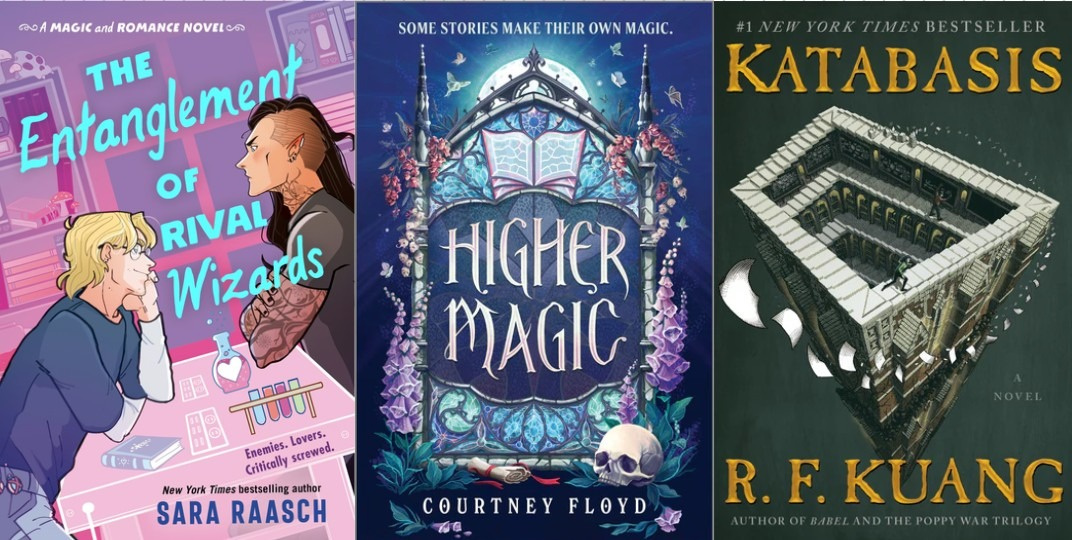
Three book covers, side by side: The Entanglement of Rival Wizards, featuring a blond human man and an elf man with dark hair on half a shaved head look at each other across a lab table; Higher Magic, featuring a stylized cover reminiscent of a cathedral window with a skull and a stained glass book; and Katabasis, which shows an Escher-like towering college building.
The Entanglement of Rival Wizards, Higher Magic, and Katabasis

The Entanglement of Rival Wizards by Sara Raasch

Getting a prestigious grant to finish graduate studies might be a dream for any grad student—but not when they have to share the funding with their bitter academic rival! That’s the situation for evocation student Sebastian Walsh, who thought he might be stepping into the career-making moment of his dreams. But to keep both his funding, his future job offer, and earn his degree, Seb has to work with conjuration student Elethior Tourael, a member of an infamously wealthy and powerful family—who are also responsible for trauma in Seb’s past. Raasch uses the grad school set up and the D&D style magical bickering to create a fun romantic m/m romp in a surprisingly convincing setting that blends magic and modern life in surprising and fun ways. Though the characters have much deeper, more painful issues than the candy pink cover implies, the relationships (friendships and romance) are well drawn, and readers will root for Seb to stop tripping himself up on his way to find happiness.

Higher Magic by Courtney Floyd

Some grad students don’t need to be motivated by a prestigious grant—they just want to be eligible to actually finish their degree and become mages like they’ve always dreamed. Dorothe Bartleby failed her exam to be qualified to complete her degree with a dissertation, and for her second attempt, her committee has advised her to apply digimancy, a form of magic that has held a prophecy of doom over her head since childhood. But when she codes a magical skull who seems to be able to narrate her own life, she begins to realize that there may be a connection between the university’s growing population of missing students and her own magic. But solving the mystery isn’t a task for just one person, and Floyd populates the novel with earnest, likeable characters driven by a sense of justice that feels on point for a current read.

Katabasis by R.F. Kuang

Where Bartleby is plagued by doubts about her own belonging, Alice Law has never doubted her own abilities and skill. Determined to be the best of the best, she decides to go to hell to retrieve her doctoral advisor, because no one else in the world will be able to help her chart her future better. Also, it’s possibly her fault that he’s dead. (Strike possibly; it’s definitely her fault.) But when her rival and one-time friend and colleague Peter Murdoch interrupts her ritual to travel to hell, saying he wants to help rescue their professor, the two of them plunge into the afterlife together. Surprisingly, some of the courts of Hell remind them an awful lot of the Cambridge of the living…

One of the fun things about this trio of novels is that it showcases how different a grad school experience in magic could be, depending on the university. The Entanglement of Rival Wizards takes place a large university in Pennsylvania where following the rawball team (an adventuring party replacement for football) is a huge part of college life. Higher Magic is set at a state university where sports plays little importance, but the bureaucracy and the unions are at the forefront. And Katabasis centers Cambridge, both in the living world and in Hell, focusing on students who know they are some of the most elite (if not the best) in the world. And yet, so many of their struggles connect, it makes for a fun set to read together.

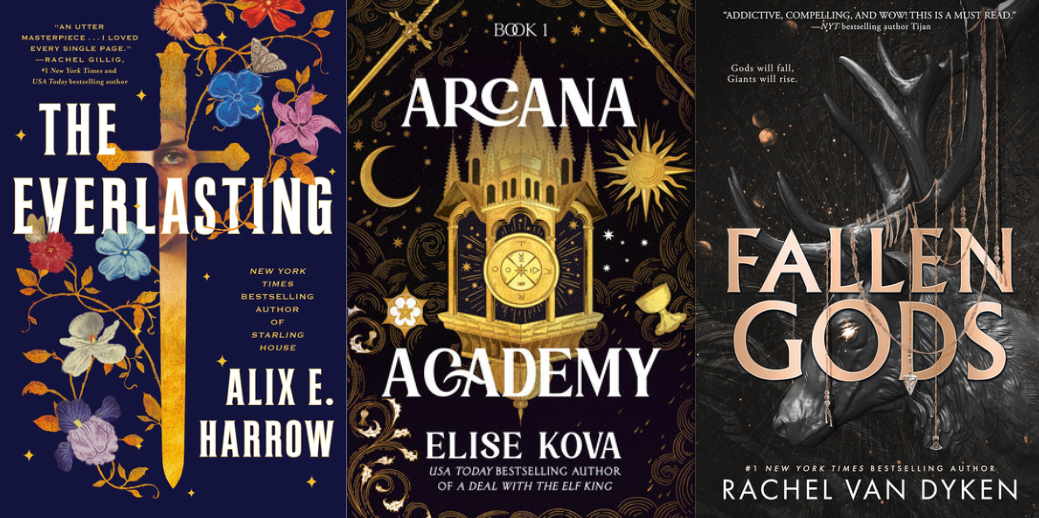
Three book covers side by side: The Everlasting, in which a face and eye look out from the silhouette of a sword; Arcana Academy, which features a golden tower-like shape against a black background with celestial stylings; and Fallen Gods, which has a dark cover with a spooky deer, its eye shining through the o in gods.
The Everlasting, Aracana Academy, and Fallen Gods

The Everlasting by Alix E. Harrow

Of course, graduate students aren’t the only ones who compete for prizes or funding. Owen Mallory, a member of the Cantford College Department of History, is ecstatic to receive a rare tome he’s spent his life searching for—which arrives mysteriously on his desk. And one of his first thoughts is to make sure that fellow lecturer Jeremy Harrison doesn’t spot it. Soon, Owen is sent back in time, through some unknown means, to make sure that national hero Una Everlasting follows the course of history that made her a hero. And still, he thinks like a competitive scholar; Harrison won’t have access to any of this primary source, after all! But soon, Owen realizes that to build the legend, he may have to betray Una herself, and as his love for her deepens, he begins to question everything he’s ever known about the legend he studied so thoroughly.

Arcana Academy by Elise Kova

Not everyone who enters academia is there intentionally, and for Clara Graysword, Arcana Academy is better served as the setting for a heist than a place of learning. But when she gets caught inking tarot cards without a license, the headmaster of the elite school, Prince Kaelis, offers her an escape. All she has to do is pose as a first year student, pretend to be his fiance, and help him steal a tarot card belonging to the king in order to create an all powerful card. Kova mixes dark academia, heist novel, and romance in this series starter.

Fallen Gods by Rachel Van Dyken

Rey, on the other hand, has been raised from birth for one task: steal back Mjolnir (yes, that Mjolnir) from Endir University, a college where gods and monsters and mortals roam the halls side by side. As Odin’s daughter, it’s her duty to obey. But when she meets Arik Erikson, her plans start to fall apart, because she can’t help her attraction her icy classmate, even though he’s the son of Odin’s nemesis. If she loses, the fate of the gods is at stake. But if she wins, she might have to sacrifice her heart. This romantasy blends the college scene with Norse mythology and a heist a lifetime in the making.

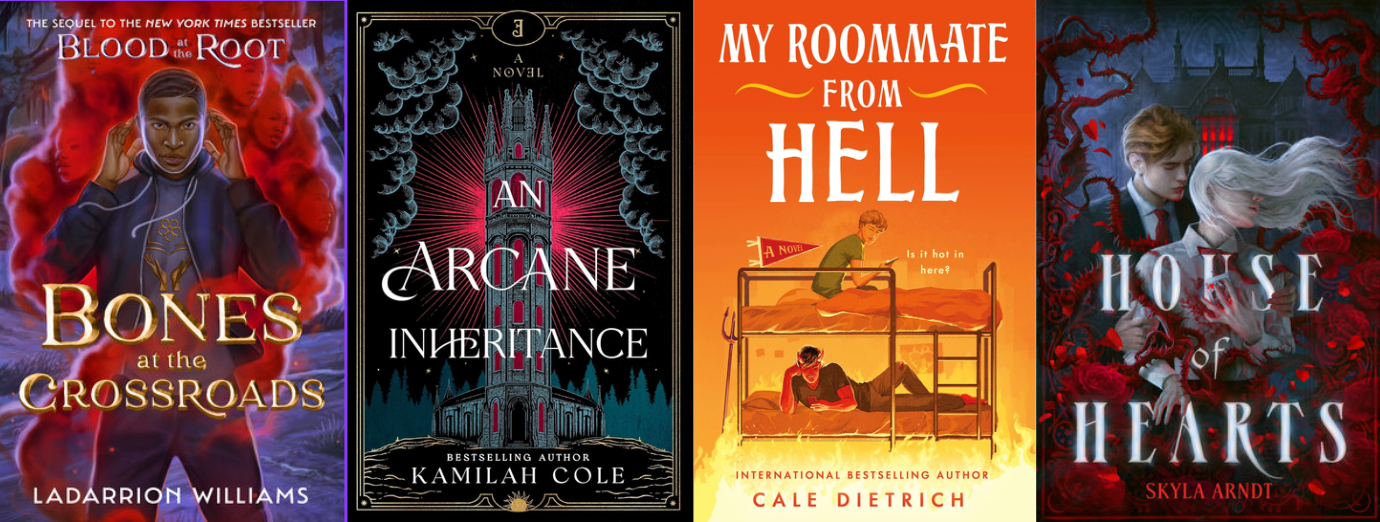
Four book covers side by side: Bones at the Crossroads, where a Black young man is surrounded by a cloud of spirits in red smoke; An Arcane Inheritance, which features a stylized tower with red beams coming from the upper levels; My Roommate from Hell, which shows college bunkbeds, with a pale young man on the top bunk and a demon on the bottom; and House of Hearts, in which a pale, white haired girl is turned away from a russet haired boy, both of them surrounded by red vines
Bones at the Crossroads, An Arcane Inheritance, My Roommate from Hell, and House of Hearts

Bones at the Crossroads by LaDarrion Williams

This sequel to Williams’s Blood at the Root returns readers to magical HBCU Caiman University, where Malik is reeling from discoveries about his powers and his legacy. The family he thought he knew, especially the mother he’d have done anything for, may turn out to be his enemies. And while all he truly wanted was a normal magical college experience, he’s realizing that he may need to use his powers to save that world—even though he’s no longer sure it’s where he truly belongs. This is a fantastic duology to pick up between installments of Tracy Deonn’s “Legendborn” cycle.

An Arcane Inheritance by Kamilah Cole

Ellory Morgan knows how to spot freshmen among the library stacks—they’re the students who don’t yet have the look of desperation and fatigue, because they haven’t discovered just how hard university is. She’s already in the thick of it, though, as one of the few BIPOC students at the elite ivy league Warren University. But worse than her courses, she has this eerie sensation of deja vu, which may be warning her that there are greater dangers at Warren than she ever realized. What forbidden magic lies beneath these halls? Ellory is determined to find out, before she loses herself.

My Roommate from Hell by Cale Dietrich

Some colleges aren’t specifically for magic. They’re just your normal college, except that after it’s been determined that the dimension of Hell is real, the world itself feels a little more magical. Owen really just wanted to have a typical college experience, but when he’s given the Prince of Hell, an exchange student named Zarmenus, as a roommate, his life is going to be anything but typical. And then, when the King of Hell demands that his son settle down, Zar comes up with a brilliant plan: pretend he and Owen are boyfriends. Zar hasn’t been the best roommate, and Owen’s not sure he’ll be a better boyfriend, but even he can’t deny their chemistry. And when anti-Hell activists try to hurt Zar, Owen realizes there’s more to their relationship than he wanted to admit. (Add a delightfully fluffy-yet-scary hellcat as a pet, and the scene is complete.) While Deitrich has some confusions about American colleges and their seasons (he’s a writer from Australia), this is a fun bit of brain candy romance that also combats prejudice with panache.

House of Hearts by Skyla Arndt

When Violet Harper enrolls at Hart Academy, it’s not to learn magic or have classes with monsters—she doesn’t know anything about any of that. She’s there for one purpose: revenge for the death of her best friend. Everyone else says it was a freak accident. She knows it was a murder, based on the cryptic messages her friend sent from the elite boarding school. Now, Violet’s at Hart, determined to bring down her suspect and make sure he pays. Unfortunately, her suspect’s brother is Calvin Lockwell, an infuriating boy Violet is helplessly attracted to. And as Violet follows her friend’s path through Hart’s halls, she realizes that there’s more haunting the school than memories—and that a curse may be behind her best friend’s death. This YA horror is full of chills and plot twists, with a slow-burn romance to keep the pages turning.

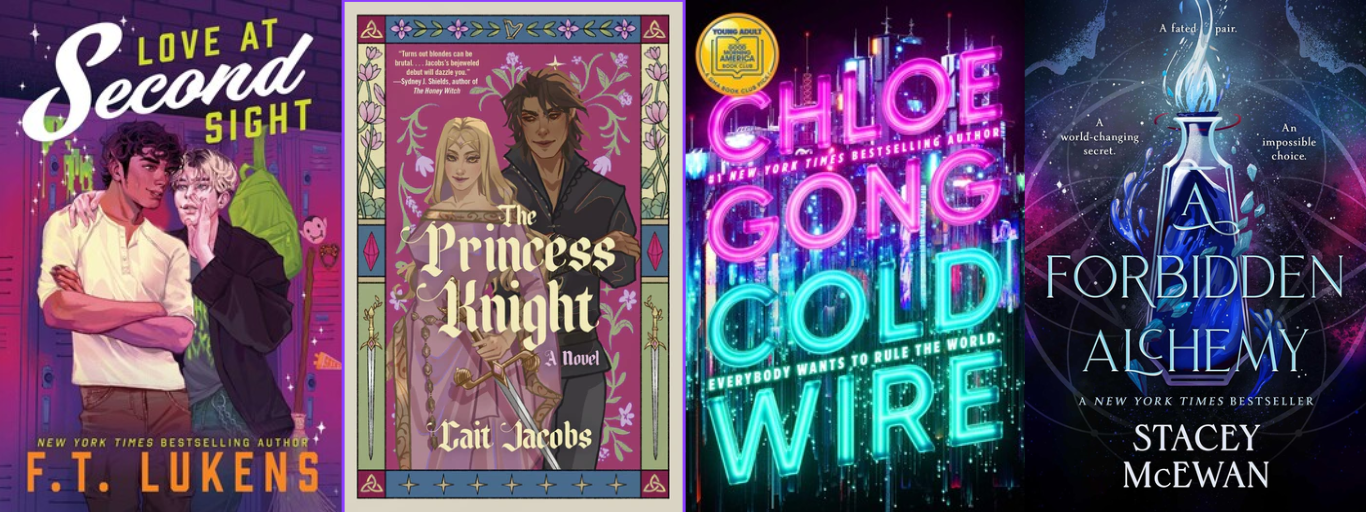
Four book covers side by side: Love at Second Sight features a high school hallway of lockers, where teens stand next to each other, one whispering to the other; The Princess Knight, which shows a blond princess with a long sword in her hand, a dusky man standing behind her; Coldwire, which features a cityscape behind the neon title; and A Forbidden Alchemy, which shows a vial of liquid, possibly flaming from the top, in front of a geometric diagram
Love at Second Sight, The Princess Knight, Coldwire, and A Forbidden Alchemy

Love at Second Sight by F. T. Lukens

It’s tough being a nonmagical student at an entirely magical high school—that is, until, Cam discovers he’s got one of the rarest magics of all. He’s a seer, gifted with psychic glimpses of the future that he doesn’t want. That’s especially true when what he sees is the gristly murder of a girl he doesn’t know. He and his friends have to solve the murder before it happens, figuring out the identities of both the murderer and the victim, while also figuring out who they can trust. (Cal also has to manage a crush on his werewolf friend, Al, but that’s fine. He won’t be distracted from the murder mystery by that tension at all…)

The Princess Knight by Cait Jacobs

Fantasy schools aren’t always about magic. Fourth Wing has an elite academy for dragon riders, and The Princess Knight has a school for warriors. Many of those who apply never successfully graduate, making those who earn their titles some of the world’s elite. Princess Clia had no intention of ever learning to be a warrior—until she is abandoned by the prince who had been her betrothed. He believes his nation, on the verge of war, needs a warrior queen, and Clia, who comes from a kingdom more concerned with parties than armies, has none of the needed training or reputation. So she does what any scorned woman would do: she enlists in military academy alongside him. (What, like it’s hard?) While this plot clearly draws on Legally Blonde for inspiration, and has many of the same story beats, the characters are wholly themselves in a setting inspired more by other romantasies than rom coms. Clia’s earnestness and self-doubt put her in direct contrast to Elle Woods, and her prince never comes across as the villain here (although he makes some utterly awful decisions). The result is a really fresh take on a familiar story, with much larger stakes than a single legal battle.

Coldwire by Chloe Gong

School settings aren’t just for fantasy! Chloe Gong’s first non-Shakespearan outing, a cyberpunk dystopia, centers on a final exam for Nile Military Academy. One of the POV narrations features Lia and her friends competing for the highest points in their field operation test, behind cold-war lines. The other centers on Eirale, whose final exam in the online world of Kathmandu has made her a valuable hostage for activists determined to bring down the corporate-military that props up the cold war. The action trades back and forth between perspectives in a race for resources that have the potential to bring down the “upcountry”—the virtual world in which most people spend their time when the real world is ravaged by pollution and pandemic. As the first in a trilogy, this may be some of Gong’s finest work yet, with detailed worldbuilding and spy-thriller twists that should keep audiences guessing.

A Forbidden Alchemy by Stacey McEwan

In this first book of the Artisan trilogy, getting into Artisan School means everything. All young people are tested to see if they have the spark of magic that will allow them to join the elite, or whether they will be destined to a life as Craftsmen, doing societies lesser respected, more dangerous jobs. It’s all Nina Harrow has ever dreamed of. It’s everything Patrick Colson hates. When the pair of them discover the truth—that Artisans are chosen, not born to their futures—they part ways and choose very different paths in the Craftsman revolution that follows. While more of this tale is about the rebellion than the school, the idea of schools shaping the future of magical students at the age of twelve has resonance with other tales, giving it a more grown-up angle on a familiar theme.

Whether you’re looking for college, high school, the lofty halls of graduate schools, or the profession of academia, there are plenty of takes on making schools—magical and not—a staple in SFF. Which ones do you think make the grade?

*Note: This article was originally commissioned by amazing editor Lacy Baugher and written for Paste magazine, which now focuses on music coverage. Thanks to Paste for all the articles over the years!
alanajoli: (Default)

Romantasy is the most popular genre to discuss right now, and there's no way readers actually want to say "to Hell with it!"—unless it's because the novel actually sends its characters to Hell. That's the case in Katrina Kwan's new novel The Legend of the Nine-Tailed Fox, which hits bookstore shelves tomorrow (February 24, 2026)!

In honor of the release, Katrina answered five questions—more reviewer-thoughts about the book follow below, so don't stop reading!

Portrait of author Katrina Kwan

Alana: Badly describe The Legend of the Nine-Tailed Fox in one sentence. (Then, tell us what it's really about!)

Katrina: A ragtag group goes on a road trip through Hell and absolutely nothing goes wrong. // A nine-tailed fox demon and a demon hunter end up trapped in Hell and have to work together in order to get out... Provided they don't kill each other first.

Alana: There have been a few novels lately about being stuck in—and having to escape—Hell (which may resonate with a lot of readers who feel like the real world has some dystopian vibes...). What was the most fun part of writing about hell as a setting?

Katrina: I enjoyed writing Hell as a twisted reflection of the world above. In Chinese mythology, the Jade Palace is a setting that's often cited both in Heaven and on earth (an as above, so below situation) and I thought it would be cool to add an extra layer by adding a version of it in the underworld, as well.

Alana: What is your favorite line from The Legend of the Nine-Tailed Fox that you can share without spoilers?

Katrina: "To be loved is to be seen. To be accepted. To be not only wanted but needed." I think this line sums up the moral of the entire novel. If we can look past our differences and accept one another, faults and all, we can find love, empathy and understanding.

Alana: In addition to your two novels inspired by Chinese myths, you've also written a culinary romance and a forthcoming heist romance. What do you enjoy about writing in these different genres?

Katrina: I enjoy writing different genres because it keeps things fresh. It takes a long time to draft a novel, and by the end of the project, I'm usually craving something new. By hopping back and forth between fantasy and contemporary romance, I get to stretch my writing muscles and give myself a palate cleanser.

Alana: If you could spend an evening with one of your characters, who would you choose, and what would you do?

Katrina: I would probably spend an evening with both Eden Monroe (Knives, Seasoning, and a Dash of Love) and Sai (The Last Dragon of the East) because I know they'd both cook up a storm and they're the least likely to stab me. We'd probably spend the whole time gossiping, eating, and drinking tea.

The Legend of the Nine-Tailed Fox cover, a mostly red, fiery background with a jade palace in the middle, and a white, nine-tailed and six-eyed fox demon swooping into the foreground

Mini-review:

The Legend of the Nine-Tailed Fox is the kind of enemies-to-lovers book that true fans of that trope will embrace. (Book Goblin, for example: Book Goblin wants REAL enemies-to-lovers, and Book Goblin would absolutely adore this one.) When they meet, Yue the nine-tailed fox demon and Sonam, an elite demon hunter, are truly enemies—he may as well be dinner for Yue, whose diet consists of humans, and she is the enemy he is determined to banish from the world. When they're both thrown into Hell, they make a pact to help each other out of sheer need to survive. Because the characters are navigating Hell, time doesn't feel linear, which means that the relationship itself feels both as though it has time to blossom and as though—once the enemies part is set aside—there's a quick road to the only inevitable path forward (which is heartbreak).But if anyone can carve destinies for themselves, it's a stubborn fox demon and an almost equally stubborn demon hunter.

Kwan also gives readers the joy of a larger cast present for almost the entire novel, so there are four characters—not just the romantic leads—who drive the story, Sonam's two fellow hunters, Wen and Sooah. They're not given the same focus, as they have no point of view chapters, but each feels as though they have a well of depth, and their devotion to Sonam bolsters his own character. (Sooah also gives readers my favorite line of the book: "'There is little time in the world', she says. 'Why choose to hate when you can choose kindness?'" Instagrammer Steph @stephs.morallygraylibrary made this post to collect more excellent quotes.)

For these characters, readers will want to go to Hell and back—and they'll be ever so glad they did. Rating: 9.7/10.


alanajoli: (Default)

(The Vanishing Bookstore was selected by paid subscribers as February’s feature title at the Virgil and Beatrice Patreon. To participate in future polls and decide what gets covered, join at the “Virgil” tier!)

When you live in era after era, time ceases to have much meaning—and yet, it impacts everything. The consequences of history are felt deeply in two recently released novels, and while the magic that powers each is hard to pin down, the sense of the past’s impact on the future is concrete.

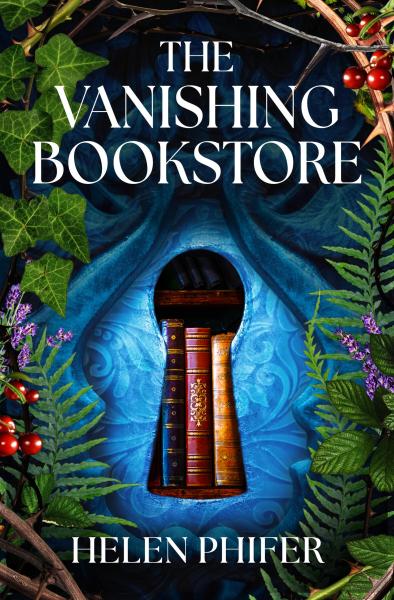
Cover of The Vanishing Bookstore: A blue keyhole, through which books are visible, is surrounded by greenery

The Vanishing Bookstore by Helen Phifer only allows for time travel in one direction, as four witches and two Puritan men live life after life following the Salem witch trials. In 1692, the English women are accused of witchcraft, likely due to the unrequited lust of witch hunter George Corwin. Though Ambrose, George’s cousin, tries to save the youngest of the women, Isadora English, the six of them become locked in repeating lives. In modern day, Dora and Aunt Lenny live in London, an attempt to try something new to break the curse. But Dora’s forgotten her past all together—and Lenny and the others believe that it will be Dora who saves them from George Corwin’s murderous ways once and for all.

Over and over, these characters are reborn into new lives in a way that’s never really detailed. (Are the English sisters always born to the same family? Is Dora always parented by the same mysterious magical man in each lifespan? Or do they appear fully grown each time around, with only Dora having a childhood in each life? The novel never gets into it, simply describing the cursed characters as immortals, who don’t look the same in each life, but not really getting into the mechanics.) Certain canon events occur, as they would in a multiverse story: Dora’s mother, Lucine, always dies first. Dora always dies before she reaches the age of 35. And George Corwin always chases them down, determined to be their downfall and indulge his murderous urges. The one thing that hasn’t happened: Dora has yet to reclaim the magical book that she and Ambrose hid in 1692—and it’s that book and Dora’s power that may finally change their futures.

While the characters in the novel don’t leap through time, the narrative occasionally does. (It might have been served to offer more of these glances, as the flashback scenes do a fantastic job informing the modern storyline. A really lovely chapter in 1764 Salem shows how Ambrose’s love for Isadora is a constant throughout time and lives.) For several of the characters, their original lives and deaths in Salem are as vibrant as anything in the modern era. History constantly threads its way into the conversations and interactions with their world around them, in a way that the setting of modern Salem embraces.

Phifer does a fantastic job of embracing the Salem setting. Readers who have visited Salem will be tickled by all the references to familiar landmarks and the names of historical figures (including the villainous Corwin). The modern English women toe the line of being at once ancient witches and being modern shopkeepers, just as Salem itself hangs onto a troubled history and reframes it by embracing a witchy ambiance that was never present in Puritan times. Capturing this intentional dichotomy of modern Salem is one of the things Phifer does best as a writer.

The tone of the novel can be odd for the content. The detached narration, after the first chapter from Isadora’s point of view, gives the book a cozy feeling, even when George Corwin is threatening to murder people. The atmosphere Phifer creates never allows Corwin to be as ominous as he should be, given how he threatens the lives of Dora’s modern friends in London, and that dissonance doesn’t work as well in tone as it does in the setting.

At its core, The Vanishing Bookstore is a book about familial love, especially between generations of women. (The romance is a little less convincing, especially the timing of a romantic interlude, but it’s a very secondary focus of the story.) The frequent references to Salem’s history make it a good choice for readers already interested in the Salem witch hunts, while the narrative choices in how the story is told may make readers feel as though the narrative undercuts itself. Rating: 6/10.

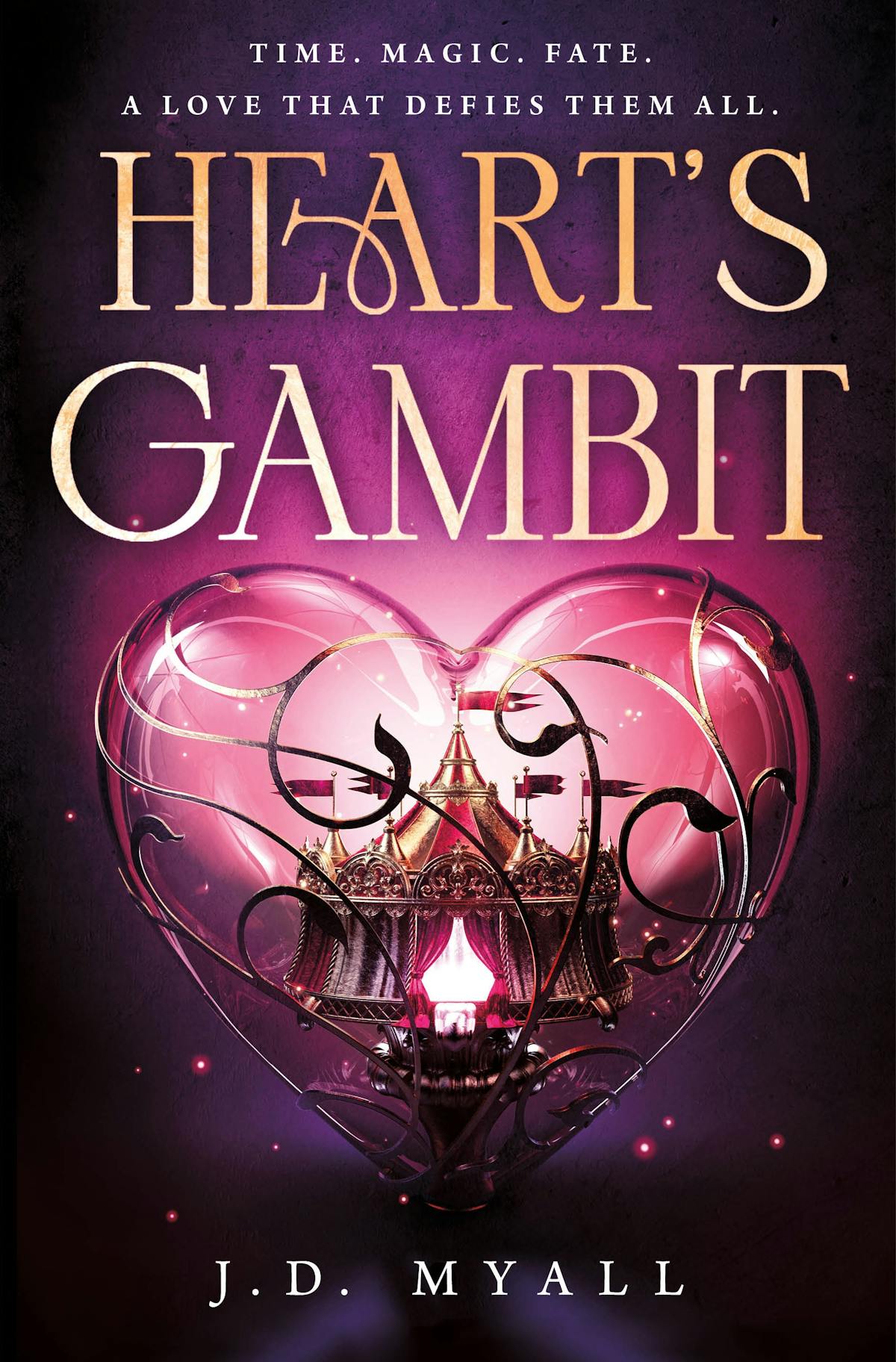
Heart's Gambit cover, in which a lit circus tent is held within a glass heart with metal filigree.

J.D. Myall’s Heart’s Gambit, on the other hand, travels back and forth across time periods, from a horrific 1860 plantation to an imagined future of glass skyscrapers and skywalks. The opening prelude shows the origins of the curse that afflicts the Baldwins and the Davenports: Sabine, the wife of a plantation owner, has made a bargain with the spirits of Grand Belle Island, giving her power over time—as long as she feeds her powers with blood. She creates a game, the Tethered Gambit, that will afflict two family lines. She grants freedom and magical powers to the Baldwins and Davenports, but with a price. Every so often, she will call on a member of each family to fight to the death in trials of her choosing. They will gain the powers of the person they kill in the trials, and she will gain continued powers in her own lifetime.

In the main storyline, which occurs primarily in 1922 and 2024 simultaneously, Emma Baldwin and Malcolm Davenport are both sick of the violence. While their families see each other as the enemy, Emma and Malcom both view Sabine as the true villain. When both are Tethered, instead of giving into the bloodlust that is part of the curse, they meet up and begin exchanging letters through time. (The magical mailbox, powered by fairies, is one of the most delightful and whimsical inventions of the story.) While the romance through letters trope doesn’t always work, here, it’s brilliant—both romantic leads go into their conversation with open eyes, unsure if they can trust each other, but soon realizing that their connection is deeper than any curse.

The set up feels like a grim mixture of Snow White’s evil witch and Romeo and Juliet, combined with real-world details of what it’s like to be Black in America at any time in history, and it works beautifully. The Baldwin and Davenport families are populated by interesting, conflicted characters who frequently do the wrong things for the right reasons—with the Davenports coming out slightly on top, as they move through history trying to make small changes that will bring about better futures, but not derail the timeline. While the magic doesn’t always feel grounded, the whimsy of it makes it easy enough to handwave, and the different locations and eras the narrative visits are all well drawn. The story is self-contained, except for the epilogue, which launches the surviving characters immediately into their next peril, so be wary of those final pages! Rating: 9/10.

Whether time travel is due to immortal rebirth or unfettered movement through the timeline, the experience of past and present (and future) intersecting is always entertaining—and challenging to pull off. But when it works, it opens up a new world to readers, making them excited to investigate the past and dream of better futures.
alanajoli: (Default)
When a disinherited princess-turned-spy gets her first assignment, she doesn’t expect it to be playing herself. That’s the hook for Braidee Otto’s new Songbird of the Sorrows, which has just hit bookstore shelves (February 3, 2026). Billed as a romantic fantasy, Songbird of the Sorrows has more in common recent epic fantasy series, like Jennifer Estep’s “Crown of Shards” or Sherwood Smith’s “Inda” novels, than books in the current romantasy wave. Some elements would feel right at home among the works of Feist and Jordan.


Cover image of Songbird of the Sorrows by Braidee Otto, showing sprayed edges; the cover features stylized plants and three starlings perched among them
 

Otto, an Australian writer, invites readers to a Greek-inspired fantasy world, where four nations were divided in a great war between the gods of the winds. Each nation stays perpetually in a single season, and summer’s nation, the Sorrows, has a very Mediterranean island vibe—Santorini and Naxos, if they weren’t filled with tourists.

But while summer might conjure vacations for American readers, the Sorrows isn’t a place that revels in its climate. It’s a struggling nation, one that may be on the brink of a new war—a conflict it’s not sure it could survive, especially not after the way the last war fractured its lands into tiny fragments.

Aella doesn’t dwell on all of this, although her first-person narration gives readers bits and pieces, enough so that the world builds itself around her. After she was banished from the palace (because, she believes, she looks too much like her dead mother), she was given to the nation’s spymaster, the Eagle, to train as a future Songbird, an elite group of spies that does the nation’s wishes. To succeed among as a Fledgling, Aella has to hide who she truly is. No one can know what has truly become of the princess. It’s safer for the nation to believe she’s been sent off to train with monks than that she remains in their nation of islands, learning to pick locks and fight from the shadows.

It’s also better if no one knows Aella’s other terrible secret. While it’s common knowledge that Aella never received the magical bloodline of the royal family, Aella and the narrative both hint early on that there are other powers bristling just under her surface. Discerning readers may pick up clues from the very first pages about what makes Aella’s magic different, but the reveal much later in the book has a big payoff, even if it’s not entirely a surprise.

After years of hiding who she is, Aella wants to be shocked that her first assignment is to take back her identity as a competitor in trials to win the hand of the prince of the autumn kingdom, Eretria. Not only would a win there give the Sorrows an insider in the Eretrian court, but her competition is to serve as a distraction so that other Songbirds (and Nightwings—the group’s assassins) can infiltrate the palace and find a dangerous weapon. There are just a few problems with this. One: As much as Aella wants to feel like she belongs, she has always felt like an outsider in the order, and she doesn’t really believe in the cause. She certainly doesn’t trust the Eagle—nor he, her. He motivates her to perform well by threatening to kill her best friend in the order if Aella fails. Two: The leader of Aella’s Flight—her squad of spies—is her ex, Raven. The two had a great romance, until he called it quits, citing the rules of their order against loving anyone more than duty, and left her behind. Now he’s back, and Aella’s traitorous heart wants to pick up the shattered pieces and try again, even as she’s being commanded to marry someone else. Three: The prince of Eretria is more dangerous (and unhinged) than anyone warned the team. (It’s refreshing to have a villain who is truly a villain, and not aimed toward a path for redemption—even as some of the darker scenes in the novel lean into the grim horror that is his villainy.) And four: The weapon is far different from what Aella could ever imagine.

Songbird of the Sorrows was originally self-published in 2024, but it found a new home (and a much revised and expanded edition) that will help it reach the broader audience it deserves as it launches Otto’s series. It has plenty of elements to appeal across subgenres—while it’s not a romantasy, it’s got enough spice to please that audience, and there are grim enough scenes that it borders on dark fantasy as well. At its core, though, Songbird of the Sorrows is the story of a young woman who just wants to belong. Aella suffers many betrayals, but Otto also populates the novel with caring, well-drawn secondary characters who have the potential to be Aella’s safety net, if only she can let herself trust them. And if only she can make it past the cliffhanger ending and into the second series installment, the pubdate of which has not yet been announced.

Readers who enjoy courtly intrigue, spies, found family, and watching characters have to choose between the rules and doing what is right (and who don’t mind a little torture), will sink into Aella’s world.

Rating: 8.5 out of 10

Buy Songbird of the Sorrows at Bookshop.org.

For more about books that were self-published and found a new audience, check out “New Life for Old(er) Books” at Paste.

For more about Jennifer Estep’s “Crown of Shards” series, read an interview with the author at Den of Geek.

 Join the conversation and support future reviews at Patreon.

alanajoli: (Default)
 The Vision

This Patreon is the start of launching a larger vision--but grand visions take time, and pub dates come whether I am ready to review a book or not, and so I decided to start a Patreon when my already pitched and prepared features were relevant. That's why I launched with a Round Up and a Review before an article that explains what we're doing over on Patreon.


When I set up this Patreon, I almost named it "Alana's News and Reviews," because I wasn't yet sure how all the pieces of my larger vision will come together. The reasoning behind launching a Patreon at all is that books coverage is getting eliminated at a lot of the usual online sites where reviews and round ups used to be part of their regular content. Places like Reactor and Book Riot are still doing the good work (and you should read them, too!), but it's getting harder and harder out here to place articles.

So, I thought I'd do it myself.

I reached out to editor friend Julia Rios, in part because their website has a lot of the features I want to end up with. (My website is woefully out of date and hasn't kept up with accessibility standards.) I'm due a refresh, and based on my conversation with Julia, I have some plans to get that done. But in the meantime, they suggested, why not set up a Patreon, make use of the newsletter feature, and start building an audience? Genius. That's why I go to Julia for advice.

The History

Yes, you say, but why Virgil and Beatrice? Settle in, friends. It's story time.

Two women, Alana and Ariel, laughing as they talk to each other

Back in ye olden days of the 1900s, when I attended college, I was among a group of students who helped run the Tutoring and Writing Center (TaWC). The professor in charge of it (Mark Vecchio, an amazing teacher who later became a psychoanalyst) gave a course about tutoring called "Guiding Dante," because writing papers can be hell, and the tutor was supposed to act as Virgil, helping to guide students through that process. Those of us who helped to run the TaWC became known as the Beatrice (Beatrix? Beatrices? I don't remember the plural!), I suppose because running the office was a bit more heavenly as a profession. Arielle Kesweder, my roommate and bestie, was one of the Beatrice with me.

In 2000, after graduating, I went to the Denver Publishing Institute at University of Denver. I came away with a certificate in publishing, got a job as an assistant editor, and had enough energy to continue to dream big dreams. The next year, Arielle also completed the Denver Publishing Institute, and we dreamed together. We wanted to create a magazine that published the types of things that we wanted to read. In honor of the TaWC, we named the dream Virgil and Beatrice.

But the thing is, we really didn't know how to run a business or get funding. (We didn't know anything about building or managing websites, either, but Scotty Allen, now the brain behind Strange Parts, which you should also check out, helped us with the basics of getting started.) We puttered around with the idea for awhile, but we ended up letting the dream go as our careers and lives took more of our time, and I turned the website into my personal home page.

Next Steps

And now? With the website redesign already on my radar, I've had a little bit of a fire lit under me to not only make the changes, but to create a place where I can continue to write the features I love. (I've also learned a little bit more about running a business after freelancing for 20 years—and, more recently, getting a job at an educational nonprofit where teaching the business of entrepreneurship is part of what we do.)

The ultimate goal is to make a website that feels like a magazine, where book coverage is front and center. It's going to take awhile to get to that end state, but the first step is creating content here.


Thanks to all of you who are over on Patreon, starting this journey with me!

alanajoli: (Default)

Stop me if you’ve heard this one. A young woman heads into the forest on a mission to save or protect someone. There, she meets a very powerful person with an amazingly cool house—but she’s trapped, unable to return home. So she has to use her wits to undo some sort of terrible magic in order to win her freedom.

The bones are familiar because it’s an old story. The most familiar (and most cited) version is Beauty and the Beast, but even that hearkens back to the myth of Eros and Psyche. The story evolves every time, which means that for all its familiar bones, the new incarnations can become very much their own thing: Sarah J. Maas’s A Court of Thorn and Roses doesn’t read like A Forgery of Fate by Elizabeth Lim. And while Silver and Blood by Jessie Mihalik begins with those same bones, the novel also borrows from other tales of empowerment and enchantment, putting tropes together in a new way to become its own very compelling series starter.

Riela is a mage, but not a very good one. She managed to save her village from a terrible flood, and now, instead of embracing her as their savior, some of them view her as a dangerous outcast. When one of the villagers encounters a monster in the woods, the town decides it’s Reila’s job to save them. Never mind that she doesn’t know how to use her magic—or even really hold a weapon; Riela saved them once, and she’ll do it again, if she knows what’s good for her.

While this might make some protagonists bitter, Riela swallows the ostracism and goes into the woods, because there are enough good people in the village that she doesn’t want to see them suffer. The alternative would be running off and revealing her magic to the king, who conscripts all mages into his service, and even if that were a thing she wanted, she won’t abandon her home and her people (whether they accept her or not).

Riela’s magic allows her to see other magic, so she begins to track what she thinks is a monster. But when she’s set upon by creatures she wasn’t tracking, it’s the magical glow she’d been following that comes to her aid. The forest, it seems, is full of monsters, and a dangerous mage is doing his best to keep them at bay. He must, because he is trapped within the confines of the woods—as is any creature of magic. So Riela is trapped, too.

The story and relationship between Riela and the mage, Garrick, progresses from here with the pacing one would expect from both a fairy tale and a romantasy. There’s a distinct attraction tinged with danger on both their parts. Mihalik savvily gives us snippets of Garrick’s point of view, revealing that he thinks Riela might be a spy out to harm him or steal from him on behalf of his many enemies. The tension between the two points of view blur; Riela is completely honest with Garrick, cowed by his obvious powers when she knows so little about her own. But Garrick views her actions through a lens of suspicion: “Every action she’d taken could be explained away as accidents individually, but together, they painted a damning picture,” he narrates. Yet he can’t help but be drawn to her, to the way she seems to trust him to have her best interests in mind, to her willingness to put herself in danger to save others. And Riela, for all that she fears Garrick and—as she learns more about who he is beyond a grumpy mage in the middle of a forest—knows better than to get involved with his affairs, can’t stop her attraction to her rescuer. (Riela’s not naïve about romance, either, having had relationships with both men and women prior to the beginning of the book.)

Keeping this review spoiler free means not revealing some of the twists of the way Mihalik uses familiar tropes—Riela’s hidden powers lean into a Campbellian hero archetype (or, at least, some of the same true-identity ground that Melissa Blair leans into in her “Halfling Saga”)—to take the story in surprising new directions. While breaking a curse comes at the end of many “Beauty and the Beast” stories, the curse really only begins Riela’s adventures. Mihalik draws on fairy stories of cruel fae sovereigns and the politics of fairy courts to create a world where Riela’s kindness is a type of superpower. And while Mihalik could easily devalue that trait and make it a weakness that gets Riela in trouble, in this book, at least, it’s a virtue that inspires others to do and be better. That feels like the kind of hero the world needs right now.

Silver and Blood leaves off on a cliffhanger (one that directly undermines the self-sacrificing hero trope, and I am here for it), with book 2’s pub date not yet announced. But it’s worth being in the first audience to read this novel, which hit shelves on January 27, 2026, because it’s likely to become a BookTok darling (featuring not a Shadow Daddy but a Moonlight Daddy likely to make Team BookTok swoon!). Mihalik also left so much room for further worldbuilding—we get a lot of the fae courts and politics in this one, but those hints about the king conscripting mages in the human world has got to come back at some point! So get ahead of the spoilers and enjoy seeing old tales become reinvented into something at once familiar and new.

For more about Elizabeth Lim’s A Forgery of Fate, check out this roundup at Paste.

For more about Melissa Blair’s “Halfling Saga,” you can read this interview about A Broken Blade, or a subsequent interview about A Shadow Crown.

alanajoli: (Default)
When I was working at our local library, I always gleefully giggled at the cozy mystery titles people would check out and return. The genre was well known for the puns in its titles (and it remained the reigning champ of puns up into the 2020s if Book Riot’s round up, “A Cozy Pundertaking,” is any indication of the ongoing trend).

But in recent years, fantasy romances, especially ones featuring modern witches, are giving cozy mysteries a run for the punny… that is, a run for their money. These eight recent titles (some of which are series starters) feature some of the best giggle worthy titles, and while your mileage may vary on which are best for you, they’re all worth the read.

Charmed and Dangerous by Shelly Page

This high school rom com, which puts two seniors up against an unauthorized magical curse, doesn’t hit bookstores until March, so pop it over into your GoodReads or StoryGraph. (Go and come back. We’ll wait.)

The story begins when junior recruit Monroe accidentally gets tangled up with the daughter of her boss, Iris. Popular—and cursed—girl Iris is determined to get back her ex, and if she pretends to be dating Monroe, she hopes that her ex will be jealous enough to buy back into the relationship. Mo’s never had time for things like dating, but when the director asks her to surreptitiously keep an eye on Iris, Mo agrees to the fake dating scheme, and (unsurprisingly) chaos ensues. Page makes great use of the YA rom com tropes, especially as Mo and Iris catch feelings for each other, and blends the romance and fantasy with a mystery undercurrent. Who is behind the dangerous charm that keeps cursing high schoolers? Can Mo solve the case without losing everything she’s come to realize that she values? But more than that, Page also gives Mo real grief over her parents’ divorce, which she can’t understand. The relationship between Mo and her parents is almost as important as the romance, and it’s the really human vulnerabilities that make this as touching as it is light-hearted fun. Rating: 9/10.

Witch You Would by Lia Amador

This delightful madcap romance is full of grumpy sunshine charm—and it’s a sweet riff on the pen pal romance (ala You’ve Got Mail but without the icky power dynamic). Penelope Delmar has gotten the chance of a lifetime: she’s made it onto a reality television show for magic users, where she can really show her talents and finally make it out of her dead end job and into a magical role where she’ll be appreciated. But when she’s paired with teammate Leandro Presto, a celebrity who’s more of a joke than a magician, she’s certain she’ll have to carry the weight for both of them. The truth is, Leandro is just a persona—the real man behind the character is Gil Contreras, an academic whose spell knowledge is off the charts. But he can’t reveal his identity, because the show wants his goofy mistakes, not the real him. What’s worse, he’s been writing emails to Penelope for months after he ordered something from the shop where she worked, and he’d love to impress her. What’s a spellebrity to do?

Add some hijinks that make the pair believe someone’s trying to sabotage the season and you’ve got a magical (and romantic) adventure. While this is Amador’s first fantasy romance, she’s also a veteran science fiction writer (as Valerie Valdes), and the same blend of comedic timing and earnestness readers may know from her “Chilling Effect” is at play here. This one’s perfect for readers who would love a celebrity baking show with a magical twist—with an undercurrent of romance that’s absolutely enchanting. Rating: 10/10.

Hit Me with Your Best Charm by Lillie Vale

This early 2025 title looks like a romance and is described as a YA romance, but it’s really an excellent creepy-woods meets dark-fairy-tale with a side of romance, and it works tremendously well. Despite everyone in Nova Marwood’s town believing in magic, she’s a skeptic. She does, however, believe that her missing father is still alive and, somehow, lost in the supposedly magical woods. She also believes that Kiara Mistry, who has somehow managed to steal every one of Nova’s crushes during their school career, is her own personal curse. So when she gets the chance to play a prank on Kiara, she takes it, accidentally laying a very dangerous hex on Kiara that only a trip to the miraculous wishing well at the center of the woods can break.

Without admitting that Kiara’s fate is her fault, Nova agrees to go on the wishing well hunt—alongside Kiara and all of her other ex’s. While there are some fun, lighthearted moments (Nova names the group the Fellowship of the Fling), there’s a lot of danger in the woods (including a very creepy bunch of other people in the forest), especially for a group of kids who don’t really know anything about camping. There’s still time for Kiara and Nova to realize that they’re into each other—the romance angle is strong, but it’s very much tangled up in themes of grief, loss, and figuring out how to do the right thing. Snuggle in with a warm blanket, a box of tissues, and a good reading light for after the sun goes down. (Bonus pun points: Lillie Vale also wrote non-magical romance Wrapped with a Beau.) Rating: 9/10 as a creepy teen horror romance (so go in expecting that!).

Hopelessly Teavoted by Audrey Goldberg Ruoff

Like Hit Me with Your Best Charm, Hopelessly Teavoted has a very singable title, and it also deals with the grief of losing parents, but the romance angle here is far more prominent. It opens in the past, when a teenage Az fails to bear his heart to the neighbor girl and best friend, Victoria, he has loved for years. After the first chapter, the story picks up in an interesting spot: Az and Victoria apparently tried dating once, everything went awful, and now they haven’t spoken to each other in years, not even after Az’s parents died of COVID. But despite that, Victoria is determined to keep Az’s mother’s tea shop open. Without the blessing of her rich parents, she buys the shop and starts her own business, following her dream.

That feels like it would be enough to serve the plot, but Ruoff brings in a lot more elements (and sometimes writes a narrative that contradicts itself—but it’s a debut novel, so a little grace is merited). Az is a witch who always wanted to hide his magic and live a normal life. But now that his parents are gone, he’s conflicted about his place in the world. Victoria, in addition to being close to Az’s family (who cared for her the way her own standoffish parents never could) has the ability to summon ghosts. So to help get through his grief, Az asks Victoria to help him send his parents off. But wait, there’s also a (super hot) demon who needs Victoria to collect three souls for him to pay off the debt her parents incurred when they purchased her talent to summon ghosts. And even as Az and Victoria reconnect, a curse gets placed on both of them that keeps them from being able to touch. It’s a lot—almost too much—to fit into one book! But the scenes of sexy-fun-times without physically touching are steamy enough to merit the challenge the characters face, and the setting and characters are entertaining to the point that the novel’s other flaws are easily forgiven. Readers will root for Az and Victoria to make it to the end and earn their happy ending through the numerous challenges their author set for them to face. Rating: 7/10.

No Charm Done by Tori Anne Martin

When two powerful teen witches prank each other, they end up creating a hex that threatens their entire town. Ace student and popular girl Lily has only ever seen Chrysanthemum as competition since the girl arrived in Lily’s ancestral (and hidden-witch friendly) hometown and won the magic bee out from under her. Goth girl Chrys only ever wanted to be accepted (and, okay, maybe had a teeny crush on Lily), but getting shunned by the local witches reinforced her belief that she can’t trust anyone—and that Lily is the bane of her existence. Lily’s beginning of the year tarot reading leads her to believe that to have the perfect senior year, she needs a boyfriend, and new boy Luke seems like the perfect candidate (never mind that Lily isn’t really attracted to him; that’s not the point). But Chrys seems poised to steal him (never mind that Chrys likes girls). When the two use their witchy talents on each other in a way that escalates into a hex, they’re both saddled with community service, working together. But their ill intent toward each other sets something more dangerous loose in town, and they have to put aside their differences (and maybe see that their animosity might have something else behind it) to set everything right.

There are a lot of 90s teen romance vibes at work here, which works even as the setting and characters feel authentically contemporary. Chrys and Lily are both especially well drawn, and while the other characters fade into the background of their dynamic, none of the secondary players feel like stock-characters. Even on the surface level, the cast gives the setting a sense of being lived in, of being a real community full of witchy tourism where the author could set future books. Martin also explores Lily’s asexuality in a way that feels genuine, in part based on her own personal experience, which is representation that’s not often featured in teen romances. Overall, the novel has an excellent use of tropes, a fantastic setting, loveable characters, and an ending that sticks the landing. Rating: 10/10.

Love’s a Witch by Tricia O’Malley

O’Malley is no stranger to Scottish fantasy romances (see: A Kilt for Christmas), but with Love’s a Witch, she launches a brand new series set in another witchy tourist town, Briarhaven—a mix of Brigadoon and Disneyland to delicious effect. The charm of the town does not win over Sloane MacGregor, though. Years ago, her mother took her and her sisters away from Scotland and to America, running from a curse that never fully lets them settle in one place, or bad things happen. Sloane’s grandmother believes it’s time for the sisters to come back and try to break the curse, so they reluctantly agree, even though Sloane doesn’t remember Briarhaven fondly. And Briarhaven apparently doesn’t like them much, either, based on both the terrible out-of-season snowstorm that greets their arrival and the growly mayor, Knox Douglas, who doesn’t want their curse to wreck his plans to make the town profitable. (Forget that Knox had a crush on Sloane all those years ago, and forget Sloane’s instant attraction to the grumpy mayor. Clearly, they want nothing to do with each other.)

The MacGregors won’t let a snowstorm or Knox stop them from trying to break the curse. They won’t even let the Stepford-wife-like coven dissuade them, even though not all of the other witches seem willing to help. Instead, the sisters are determined to make the community like them if it kills them, because once they end the curse, all they really want is a place that feels like home. O’Malley nails the sense of longing here, both in the unrequited romance and the desire to belong to a community, and that earnest core is the foundation on which the fluffy humor succeeds. This is a delightful Scottish romp, and while it treads into some heavier issues, overall it’s pure fun. Rating: 10/10.

Best Hex Ever by Nadia El-Fassi

Although Best Hex Ever is a 2024 title, it’s included because it has a great title and because it sets up El-Fassi’s 2025 title in the same world Love at First Fright. The first book centers on Dina, a kitchen witch with Moroccan heritage, who is under a hex: Anyone who falls in love with her, or who she gets too serious about, is in danger of serious supernatural harm. Naturally, she pushes people away, even people she’s extremely attracted to—like curator Scott Mason. Their first off-chance meeting at Dina’s café feels like the beginning of either something wonderful, or Dina’s doom. When they discover they’re the maid of honor and best man at their best friends’ wedding, it seems like fate is all but pushing them together. Scott, recovering from a bad relationship, has never fallen for someone so fast—but he’s also never met anyone like Dina before. He’s ready to do whatever it takes to convince her to give them a shot.

El-Fassi’s fantasy romance is the steamiest one on this list, with plenty of explicit spice (and not the kind from Dina’s pantry) on the page. Scott and Dina both have insecurities that the reader sees from their own points of view, so rooting for them to overcome and find love is easy. The surrounding cast is also a delight, with the couple getting married, along with Dina’s other best friend, being instrumental in setting up the two leads. (There’s only one cabin! It’s not quite the more famous trope, but the forced proximity is quite intentional on the part of the friend group, if not the narrative.) Additionally, the magic is whimsical and beautiful; Scott’s delight in being in on the secret, as a curator who has long studied luck charms from different cultures, really helps the magic feel wonderous. The first novel will definitely have readers eager to pick up the second (and luckily, both are out now!). Rating: 8/10.

Witchful Thinking by Celestine Martin

This is also an older series starter (2022), followed by similarly wonderfully punny titles Kiss and Spell (2023) and Deja Brew (2024), each featuring the love story of one of the Jersey Shore witch Carraway sisters. In Witchful Thinking, Lucy accidentally spells herself into a more exciting life. Thanks to her wish for pushing her boundaries and opening her doors, she has to say yes to things outside her comfort zone, whether that’s running a 10k or hooking up with her high school crush, Alex, who’s only back in town until he can sell the house his parents saddled him with. (It’s also Lucy’s dream house, but neither of them see that as fate pushing them together.)

This is Martin’s debut novel, and there are a few clunks here and there in the way the story is told—but the story is such fun that it doesn’t matter. The charming Carraway sisters are compelling enough to want to follow them across further installments (despite—or perhaps because of—their sibling conflicts), and the delightful town of Freya Grove is worth the investment in the series. Rating: 7/10.

Obviously, the pun doesn’t stop here. What are your favorite pun-worthy titles for romances, witchy or otherwise? Let me know in the comments at Patreon—and tell me what you’d like to see more of here at Virgil and Beatrice!

alanajoli: (Default)
I've not been as active a blogger or article creator as I once was, in part because there seem to be so many ways to interface with the audience interested in reading my thoughts. Some of this shift is due to the way all my interactions with people have changed over the past two years; if the pandemic has brought any joys into my life (aside from the quality time spent with my immediate family), it's that I discovered Bookstagram.

I've been a reviewer for years—professionally for almost two decades! I receive a lot of review titles that I have the opportunity to cover. It's been incredibly fun to cover so many books at Den of Geek since I started writing there, and we've had a great time covering games, comics, and prose as a team at Outland Entertainment. (We're creators, but we love to consume media, too!) After I started updating my Instagram account (initially under protest, but Tara Cloud Clark insisted that adding one more social media account was important), I realized how much fun people were having with books. Makeup to match the covers! Props and beautiful backgrounds! Preorder goodies! Video or text reviews to go along with the images! I was won over.

So of course I started creating my own content. Some of the fun is finding the right location, like the steps of the Blackstone Library to feature Chantel Acevedo's #MuseSquad books.

The Muse Squad duology against a Greek-architecture inspired background

I've made use of multiple backgrounds inside my house, like this shot of Jayci Lee's A Sweet Mess on my stove.

Jayci Lee

And I've realized that not every shot works with Instagram's framing; this shot of a book haul, complete with my Christmas cactus as an accent, ended up as just a book stack, minus the cactus, when I eventually posted it.

A book haul shot that

Every new post is a bit of an experiment, but the process of learning has been fun. If you're interested in keeping up with my regular posts and short reviews, give me a follow!
alanajoli: (mini me short hair)
Happy New Year! It's been some time since I posted; it was a busy year at Casa Abbott for non-writing reasons. We've welcomed baby Fish into our family, joining his sister Bug, Three-stripe, cats Jack and Tollers, and I as members of our household. But while I'm behind on many things, I've continued to read a lot! Since I posted last year and the year before about my reading goals, I wanted to post last year's results and this year's goals before 2015 progressed too far!

This year, I did not count all the picture books I read, but I did count all my review picture books individually. For the year, I totalled 163 books, which is up from last year's 129 (probably in part due to counting all the review books individually). There was a method to my madness, however: I wanted to see what percentage of titles were review books as compared to non-review books. Here's some of the interesting breakdown:

  • 89 titles were review books

  • 106 were children's or YA books

  • Only 12 were graphic novels, which is rather low

  • I read 7 romance, 69 SFF, and 2 nonfiction


I did reasonably well on my goals. The 2 nonfiction titles beat my goal to read just 1. I read 13 out of the 15 novels from my TBR pile I'd hoped to read, 4 titles by autobio writers, 6 rereads (out of a goal of 3), and read one non-genre novel.

The most interesting statistic I kept last year was print vs. digital. I surprised myself by reading 91 books in paper and 72 digitally. I thought I skewed toward e-books, so it's interesting to me that I'm not even at 50% digital reading. Some of this is due to reading for the MFAs. I rely heavily on the library to provide me with MFA reading, and though some are available as e-books, most are more readily available in print.


Highlights of the year?
  • Rereading Max Gladstone's Three Parts Dead--and seeing it make the MFA finalists list--was great fun. It's been especially fun to read more of the Craft books, both post-publishing and in mss format, in combination with playing Max's Craftverse game Choice of the Deathless. Without the books being required for the game and vice versa, they work so well in conjunction!

  • Finishing Devon Monk's "Allie Beckstrom" series was bittersweet, but starting the "House Immortal" books makes me confident there's more excellent reading to come.

  • I had the fantastic opportunity to interview Gene Luen Yang for the autobio project, and I read The Shadow Hero and Boxers and Saints in preparation for that. They were both some of my favorite reading for the year, for very different reasons. I'd recommend The Shadow Hero to anyone, but especially readers who have a fondness for Golden Age superheroes. Boxers and Saints is a fabulous moral and ethical investigation of a historical period with a lot of magical realism thrown in, and I found it both enjoyable and tremendously moving.

  • The biggest surprise read was probably Eleven by Tom Rogers. It's a book about 9/11, mostly from the perspective of a boy who's just turned 11, and it's fantastic both as an exploration of the event through fiction for middle graders and as a coming of age story. It was also pretty wild to realize that 9/11 happened before the middle grade age group was born--so it qualifies, on some level, as historical fiction.

  • I'd also recommend without reservation the Super Lexi middle grade books by Emma Lesko. Lexi is neurologically and developmentally different from her peers, which makes her a fascinating POV character, and Lesko's commitment to neuro-diversity in children's books shows in how beautifully she captures Lexi and makes her so easy to empathize with.

  • I loved finally finishing Shanna Swendson's "Enchanted, Inc." series, which for ages looked like it wouldn't get to continue beyond book four. (I'd still read more books in that world!)

  • I'm also really eager to see where the "Kate Daniels" (Ilona Andrews) and "Safehold" (David Weber) books end up next!


There were, of course, a lot of other great books, but listing them all would be fodder for TLDR (if I haven't already hit that point).

I was pretty happy with this year's goals, so I'm planning to keep them the same. Here's to another year of good reading!
alanajoli: (mini me short hair)
For awhile, I was burned out on vampires. I'm still not 100% back in the fold; as I told editor Rose Fox back when I was reviewing for PW, I'm running out of things to appreciate about vampire novels in paranormal romance and urban fantasy. (Which is not to say that the appearance of a vampire is enough to irk me; I don't mind vampires, but I've stopped picking up vampire novels, if that makes sense.)

Vampires are problematic. Even at their most civilized, they're either predators or parasites on humanity, and a good vampire novel should give me some cool insight into that, or insight into what it means to be a predator or parasite (if told from the vampire's point of view). That's what I'm looking for, anyway. I know the whole smexy vamp scene works for some, but there's nothing inherently cool about fangs or blood that draws me.


Unless the story is going back to vampires older than Stoker's popular Dracula icon. What prompted this post today is that I was reading a kids' folklore book about vampires for SLJ and I remembered a YA vampire novel I'd really loved--because it was based on older-than-Vlad-III Eastern European folklore. But I couldn't, for the life of me, remember the title, and since I read it before I started my book log spreadsheet, I didn't have a record to check. After some searching, I found this excellent review by Christina Chavez over at CSUF YA Book Reviews of Marcus Sedgwick's My Swordhand Is Singing. This, my friends, is the book whose title I keep forgetting, and it is an excellent and scary modern novel based on some of the spookiest vampires I've read. These walking corpses are out to kill the family members they left behind. Tricks like crossing water to prevent being chased, or throwing millet seeds because vampires can't help but stop and pick them up, feel fresh, not because they're new ideas, but because they're not as frequently used as so many other elements in vampire lore. The story is ultimately about the relationship between teen hero Peter and his father, rather than about the relationship between Peter and vampires, and I think that's part of the strength behind this book in a genre that so often identifies with the monsters instead of fighting them.

A friend posted on facebook recently about how much horror (mostly talking about film) has changed since the pre-90s creature features fell out of style. I noted that because a lot of horror and urban fantasy novels use the point of view of the monsters, the stories tend to focus on different themes:

  • identity politics (esp. for vamps and weres--what does it mean to have a secret identity as something despised by humanity?)

  • coming to terms with the drudgery of modern life (because how many of us have had jobs where we're "office zombies"?)

  • embracing/taming the violent sides of ourselves (mostly weres)

  • humans can be more monstrous to each other than any horror monsters

I love exploring those themes (and I'm sure there are others), but sometimes it's nice to sit back and watch humans be the heroes, and legitimately scary monsters be the villains. Sedgwick's My Swordhand Is Singing is satisfying for that reason, for its really excellent use of folkloric elements, and for creating a sense of historical period that feels concrete. I highly recommend it--and I hope I won't forget the title again!
alanajoli: (mini me short hair)
Back in 2008, I gave a very short but glowing review to a debut novel, Standard Hero Behavior, by John David Anderson. When I discovered earlier this year that his second novel, superhero book Sidekicked was coming out, I rejoiced, not only because it meant more by Anderson, but also because Anderson was now an online presence: he's got a blog and is on Facebook. His blog used to allow comments, so I did get to gush on how much I was looking forward to the new novel before comments were disabled. (He was very humble in response, as I recall, though I can't find proof of that now.)


Sidekicked did not disappoint. The book stars Drew Bean, the Sensationalist, a sidekick who doesn't have much in the way of combat ability; instead, he's got heightened senses, which is as much a pain on meatloaf day at school as it is when Drew is hanging over a swimming pool full of acid, waiting to be rescued. (Hey, at least he can tell you what kind of acid it is, just by smell.) When a major villain, thought to be dead, returns and frees his henchmen from the prison for supervillains, everyone is looking for Drew's hero, who defeated the villain the last time, but who has since vanished from the public eye. Drew's looking for him, too -- the man who was once his idol has left him on his own, making him less of a sidekick and more of an aside thought. It's tough to be Drew, but this young teen never gives up, and when he believes his friends are in danger, or just that someone has to do the right thing, he's willing to throw himself in the thick of things. Even when the results are disastrous.

While Standard Hero Behavior was a quest novel that ends up being as much about the relationship between father and son as it is about going on a heroic journey in a high fantasy setting, Sidekicked is about learning who -- and how -- to trust if you're a superhero in training whose Super has left the hero scene. But while I expected that mentor/mentee relationship to be the most important, it turns out that it's an entirely different relationship on which the plot hinges. I figured out the big reveal a little ahead of the characters in the book, but Anderson kept me guessing much longer than I expected.

From what I've been able to gather, Anderson is extremely under-read and under-known for the quality of his work. I think this should be remedied, so I hope you'll go check out his books, and then tell someone else about them, too. Anderson is off to a really strong start with his first two novels, and I hope that the book market will support him in publishing many more!
alanajoli: (mini me short hair)
I just heard from my editor at Kirkus Reviews about a great contest they've announced for the 80th anniversary of the periodical. I'm posting the press release here verbatim -- you should all check it out!

--


FOR IMMEDIATE RELEASE

MEDIA ALERT

What: Kirkus is giving away a trip for two to New York City.

Why: In celebration of its 80th birthday, Kirkus Reviews is hosting a contest to give away a literary tour of New York City. The winner will receive two round-trip tickets to Manhattan, two nights’ stay at the Library Hotel, two passes to the Greenwich Village Literary Pub Crawl, gift certificates to several of the city’s finest independent bookstores, breakfast at a round table at the Algonquin Hotel, and dinner at Public in SoHo.

How: Visit www.kirkusreviews.com/literarytour and enter one’s email address and name.

When: Entries will be accepted from Monday, September 16, 2013, until midnight on October 22, 2013. The winner will be selected on October 23, 2013.

Where: Visit www.kirkusreviews.com/literarytour to enter or learn more.

Who: Founded in 1933, Kirkus has been an authoritative voice in book discovery for 80 years. Kirkus Reviews magazine gives industry professionals a sneak peek at the most notable books being published weeks before they’re released. When the books become available for purchase, Kirkus offers the book reviews to consumers on Kirkus.com and in a weekly email newsletter, giving readers unbiased, critical recommendations they can trust.

Kirkus also has a full suite of author services, including Kirkus Indie, a book review service for self-publishers; Kirkus Editorial, book editing services for unpublished and self-published authors; and Kirkus Marketing, services that help authors get discovered by consumers as well as industry influencers, such as publishers, agents and film executives.

# # #
alanajoli: (mini me short hair)
I've been very lucky to get put on the press list for Jim Hines's Magic Ex Libris series, and it's been great that Black Gate has run the reviews. Last August, I reviewed Libriomancer, and a couple of weeks ago I submitted a review for the newest book in the set, Codex Born. Here's the beginning -- and you can click through the link to read to the end over at Black Gate.


--

There aren’t many writers who can start with the concept of a literal fantasy woman, pulled from the pages of her book to fulfill her lover’s dreams, and turn her from a slave into a complex hero, struggling to understand her own identity and to create herself as a real person. Jim Hines is one of them.

Codex Born, the sequel to Libriomancer, is narrated by fantasy book lover and magician Isaac Vaino, but in many ways the book belongs to Lena Greenwood, a dryad drawn from a pulp SF novel and Isaac’s girlfriend. Libriomancer concluded with Isaac and Lena and Lena’s girlfriend (Isaac’s former therapist) Nidhi Shah agreeing that they’d embark on a shared relationship — both Isaac and Nidhi would be Lena’s lovers, which would allow Lena, product of her book, and thus destined to conform to her lovers’ desires, a chance to become her own person by existing in the conflicting space between Isaac and Nidhi. In Codex Born, that relationship starts to play out — both Nidhi and Isaac struggle with the dynamic, but keep on trying for Lena’s sake — and Lena continues to hope that she can find a way to preserve who she is, even if something happened to Isaac or Nidhi.

Read the rest of the review.
alanajoli: (mini me)
There are few things that sap my motivation as much as having a cold, and my house got hit last week with a whopper. Threestripe and I are both on the mend, but it's been a quiet, sleepy time around the house as we've made our best efforts toward recovery. Thankfully, the Kickstarter was in its two-week quiet period after the funding was raised but during which any kinks got worked out. Luckily, we had very few kinks, and all should be progressing forward very soon. Shawn Merwin already has Into the Reach in his hands to edit, so I expect the momentum to start gaining on that project very soon.

JohnnyIcon

In the meantime, I've been following a couple of other Kickstarters, including Fireside Magazine, which got funded and now has its submissions guidelines posted for flash fiction. I'm thinking of taking a look at my 3000 word short story draft of "Retirement" and seeing if I can cut it down. It needed work anyway, and maybe reducing its size would work out some of the problems that substrater Max Gladstone helped me identify when I first wrote it. (Speaking of Max, he has a guest post on Romance of the Three Kingdoms up over at A Dribble of Ink. Check it out!)

I've also begun work on my next Choice of Game, a Western currently titled Kidnapping at Willow Creek. As that's just starting, it's fun to see Choice of Kung Fu still getting some Internet love. Club Floyd, a group that plays interactive fiction together, played through Choice of Kung Fu awhile ago, and the full link to their experience of the game is available up at All Things JACQ. If you haven't played it, this is full of spoilers -- it takes you through all of Club Floyd's decisions on how to play the game through. There are multiple endings, of course, and multiple ways to get there, so if you're interested in seeing how other people played it, this might be a fun read. (Their commentary was certainly fun for me to see!)

In addition to writing, I'm reading longlist books for the Mythopoeic Society Fantasy Awards, review books for PW and Kirkus, and I'm one of the readers for the Amazon Breakthrough Novel Awards this year. It's the first time I'm reading for ABNA in the romance category -- I've done the YA section before -- and I'm having a great time. The two titles I've read so far were really enjoyable, and I have high hopes for at least one of those titles to make it into the final rounds. It'd be nice if the rest of my titles were as fun as the first two!

Since I can't talk about most the books I'm reading -- what are you reading now, and what would you recommend to other readers?
alanajoli: (mini me)
So, the world didn't end in December. That's just the start of the good things on my list as we're entering 2013.

Yesterday, first day of the year, I got a (small) royalty check from the sales of Into the Reach and Departure, which is a great way to start a new year off right! I checked my sales report today, and the 99 cent sale definitely encouraged people to buy the books. So hurrah for that! I'm leaving the sale open through this weekend, and after that will be putting the books up at $2.99, which is the price point that I, as a reader, will impulse buy. At any rate, I'm thrilled with the uptick in sales and am glad that people are out there reading the novels!

In addition, people have been saying nice things about Choice of Kung Fu. I don't know why it didn't occur to me that it would get covered in reviews, but I was surprised a few days after its release to see a lot of app reviews up on Google and iTunes -- by people I don't know. And most of them were nice! There were two really insightful reviews by bloggers that I thought I'd link to here: Dora at Casual Gameplay called the game "a rich, compelling narrative set against the backdrop of mystical ancient China" in her review. Tof Eklund of TouchArcade really got some of what the game was trying to do beyond just martial arts adventure; he wrote "what amazed me was seeing the Buddhist, Taoist and Confucian strains of thought, complete with their conflicts (but never categorical oppositions) that play out in the game, and seeing the opportunity to play according to those philosophies, or reject them all." I can't say how excited I am to see someone not only recognize my efforts in that direction, but to think I pulled it off.

Beyond reviews, my buddy Brian LeTendre wrote up a really nice piece about me and my work at his blog See Brian Write. I've really been enjoying Brian's web comic MoStache, and I've just (belatedly) purchased his novel Courting the King in Yellow, which promises to be full of Lovecraftian goodness. Knowing Brian as a gamer as well as a reviewer and podcaster, I know he tells a great story in person, so I'm looking forward to reading his prose!


In other news, 2012 was not an entire success: I did not make my reading goals for last year. Although I did read one non-work related nonfiction book (John "jaQ" Andrews's Quicklet on Castle Season 3, a novel by an autobio writer (The Silver Bowl by Diane Stanley, plus several David Weber novels), three rereads, several new graphic novels that weren't review books, and four kids books that weren't for MythSoc, I only read one novel outside my genres (The Orchid House by Lucinda Riley), and only drew down my physical TBR pile by two books instead of twelve.

This year, I'm setting that TBR goal higher, and repeating most of the other goals. Interestingly, out of 141 books I read (sometimes grouping together kids books and graphic novels), around 80 of those were for review for the various publications I write for. Which explains to me why maybe I missed a few of those goals I'd set for myself. To good reading in 2013!
alanajoli: (Default)
I admit, I have largely stopped doing volunteer writing. When I first started doing game-writing, I worked for free, or worked for product credit. To me, this was doing time: eventually, by doing enough volunteer work, I'd get some writing gigs. And largely, that process worked. Which meant that I stopped volunteering.

Ah, but Alana, you say. You blog. You write reviews you don't get paid for. You guest blog. You post free fiction from time to time. How does that gel with your aforementioned mercenary disposition?

In truth, it doesn't always gel, and that's why a lot of those free projects get pushed aside for contract work. But while I don't have a great answer to that question, I thought that Ilona Andrews did a fine job describing the free vs. paid conundrum here. She (or, really, they -- Ilona Andrews is a husband/wife team) are currently publishing a free serial (link on the cover image), which eventually they'll turn into an e-book for pay, but in the meantime are doing it for-the-love.


Here's where I think this works in their favor. When I get free stuff from a writer, and I like their stuff, I'm far more likely to shell out for their books, e-books, heck even t-shirts based on their work. I think a lot of free writing (blogs included) creates a sense of community, ownership, and loyalty. This is absolutely true of Web comics -- just look at the Kickstarter success of Rich Burlew's Order of the Stick -- and I think it works for fiction writers, and even publishers (look at Tor.com), as well.

At any rate, the Andrews's thoughts are quite insightful. Clearly the topic has been discussed whenever Pixel-Stained Technopeasant Day comes around (link is to James Patrick Kelly's Asimov's article on the debate), but with all the interesting ways of getting content to readers that are growing and changing (crowdfunding, donation-driven, free, traditionally paid), I think it's a conversation that continues to be worth having.
alanajoli: (Default)
Remember how I mentioned doing author interviews for PW and Kirkus? Well, both of my most recent author interviews are up online. The first, for Kirkus, was with Arthur Mokin, a documentary writer who has published a tale of the Exodus in Meribah. The book uses a main character who is an Egyptian, and whose outsider view allows him to give commentary on the Hebrews in exile. I think it's a pretty insightful book, and Mokin was a lot of fun to interview.

For PW, I interviewed Kij Johnson, whose short story "Ponies," which blew me away when I read it on Tor.com, is featured in her new collection, At the Mouth of the River of Bees. The print portion of the interview is here, but it's probably behind the paywall until next week. The rest, and longer, portion of the interview is over on Genreville. Kij is one of those writers who, when I read her, I thought, How have I not read her work before? Her back list isn't terribly long, but it's one I look forward to fitting into my schedule.

Speaking of PW and Kirkus, both of which I review for, I am still inundated with review books at the moment, with three graphic novels due on Friday, another two due next week, and two more novels for July, as well as a pile of books I've been meaning to review for Flames Rising and an ARC for Black Gate. Whew! It's a good thing I read quickly!

Profile

alanajoli: (Default)
Alana Joli Abbott

March 2026

S M T W T F S
123 4567
8 9101112 1314
151617 18192021
2223 2425262728
2930 31    

Syndicate

RSS Atom

Most Popular Tags

Style Credit

Expand Cut Tags

No cut tags
Page generated Apr. 5th, 2026 12:29 am
Powered by Dreamwidth Studios