![[personal profile]](https://www.dreamwidth.org/img/silk/identity/user.png) alanajoli
alanajoli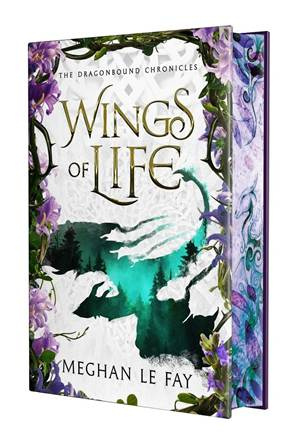
Wings of Life has a lot of familiar plot elements, brought together in fresh ways. (Light spoilers to follow.) Le Fay uses a first person point of view, swapping perspectives to offer readers a rounder vision of the world she’s building—and letting readers in on the truth behind the misunderstandings that propel the narrative. The novel opens with a chapter from the point of view of Bale, the heir to the feudal region of Cavendaffe in the kingdom of Inra. There’s been a war between Inra and Rihtlond for ages, but Bale’s unit has been covertly sent to fight a different enemy. As the chapter ends, Bale is seemingly meeting his fate—and in Sarae’s first chapter, the family receives a letter that Bale has been killed in battle.
Immediately in Sarae’s point of view, readers are thrust into the intrigue among nations. It turns out that war with another neighboring nation, Volaach, is either imminent or is what’s behind Bale’s death. So an alliance with Rihtlond, those “savages” from the north, is necessary—except that obviously the margrave of Cavendaffe is under orders from the crown to send his daughter not as a bride, but as a spy. As soon as Rihtlond’s secrets are uncovered, Inra will betray their new allies. To what end, when war is at their other border? To be honest, the plotting of the men who govern Sarae’s life is perplexing and full of greed rather than logic—which seems sure to tip the world closer to it doom.
Though Sarae chafes at the traditional gender roles in Inra (she’s smart not simpering; she’d like to have some say in her fate, etc.), she can’t imagine anything good coming out of being sent to Rihtlond. Even as she begins to realize that the so-called savages have a deep sense of honor and a well of reverence for living dragons—which Inra proclaims have all died out—she still can’t see a future for herself other than the one her father has determined for her. It takes a huge upheaval (and, yes, a dragon) for her to even imagine that she can change her future at all.
Sarae’s character growth, realizing that she can be more than she’s been told (and growing out of her youthful romance into lusting after a man she thinks is her fiancé’s brother), is really the core of the story, even more than the romance. (Eldreth, the love interest, is a solid, earnest, honorable man—and, of course, oh so sexy—and their sexual tension is well developed. But while the growing relationship propels the plot forward and gives Sarae her motivation, it comes behind the importance of Sarae’s relationship to her dragon—and to herself.)
While there are a few quirks of narrative that made me pause (a few sentences here and there had what struck me as an ableist overtone; the Riht is a little too perfect compared to Inra; the world-building hinges on the light and dark as good and evil metaphor, which I wish more books would steer away from), overall this is definitely the type of book that will appeal to the Fourth Wing fandom. Sarae starts out as a nerdy girl who speaks her mind more by accident than because of her spine (because her father has beaten her when she’s shown independence—it’s that type of book). She trains physically to learn warrior skills—she’s best with the bow, which I loved, especially because Le Fay knows that you nock an arrow to the bowstring (not notch!). The diverse group of Sarae’s warrior cohort becomes her found family, and the dragon—trying to avoid spoilers here—is increasingly awesome as the book goes on. The way magic works is fun, and there’s a promise of more development there in the sequels. The spice is lighter than a lot of romantasy novels, which is likely to make Wings of Life appeal to readers who wanted fewer graphic scenes without sacrificing romance or plot, and it works here. (Much of the romance plot hinges on a huge misunderstanding, so if that is not your trope, be warned!)
Le Fay’s series is off to a strong start, and the book as an artefact is gorgeous. I read this mainly as an e-book, and when I picked up the physical version, the experience was so enhanced, I wish I’d read it as a hard copy from start to finish. Font and interior design really can have an impact on reading experience, and the crew that made this novel so beautiful inside deserve a shout out!
Wings of Life hits bookstore shelves on May 26! You can preorder it now from Bookshop.org.


